
830. A pathway toward clinical translation of hyperpolarized [1,4-¹³C₂,2,3-d₂]fumarate as an imaging biomarker for early cellular necrosis in vivo
Jonathan R. Birchall, Pascal Wodtke, Ashley Grimmer, Esben S. S. Hansen, Lotte B. Bertelsen, Nikolaj Bøgh, Marta Wylot, Maria J. Zamora-Morales, Otso Arponen, Ines Horvat-Menih, Elizabeth C. Latimer, Fung Tan, Evita Pappa, Johann Graggaber, Joseph Cheriyan, Kelly Holmes, Matthew J. Locke, Helen Sladen, Joan Boren, Mikko I.Kettunen, Anita Chhabra, Ian B. Wilkinson, Christoffer Laustsen, Kevin Brindle, Mary A. McLean, Ferdia A. Gallagher, MagnResonMed, (2025), 10.1002/mrm.30519
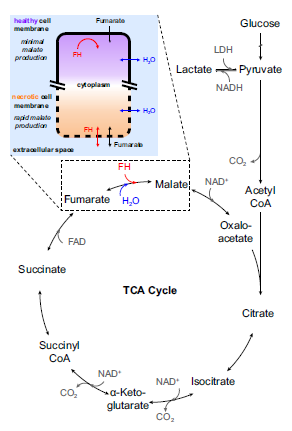
Purpose: The detection of hyperpolarized carbon-13 (HP 13C)-fumarate conversion to 13C-malate using 13C-MRSI is a biomarker for early detection of cellular necrosis. Here, we describe the translation of HP 13C-fumarate as a novel human imaging agent, including the evaluation of biocompatibility and scaling up of the hyperpolarization methods for clinical use.
Methods: Preclinical biological validation was undertaken in fumarate hydratase-deficient murine tumor models and controls. Safety and biocompatibility of 13C-fumarate was assessed in healthy rats (N =18) and in healthy human volunteers (N =9). The dissolution dynamic nuclear polarization process for human doses of HP 13C-fumarate was optimized in phantoms. Finally, 2D 13C-MRSI following injection of HP 13C-fumarate was performed in an ischemia–reperfusion porcine kidney model (N =6).
Results: Fumarate-to-malate conversion was reduced by 42%–71% in the knockdown murine tumor model compared to wildtype tumors. Twice-daily injection of 13C-fumarate in healthy rats at the maximum evaluated dose (120 mg/kg/day) showed no significant persistent blood or tissue effects. Healthy human volunteers injected at the maximum dose (3.84 mg/kg) and injection rate (5mL/s) showed no statistically significant changes in vital signs or blood measurements 1 h post-injection. Spectroscopic evidence of fumarate-to-malate conversion was observed in the ischemic porcine kidney (0.96 mg/kg).
Conclusion: HP 13C-fumarate has shown promise as a novel and safe hyperpolarized agent for monitoring cellular necrosis. This work provides the basis for future imaging of HP 13C-fumarate metabolism in humans.