
727. Stimuli-Responsive Supramolecular Gels from Fatty Acid Amides for Theophylline Delivery and Anticancer Applications
Meenakshi, Manisha, Yangala Sudheer Babu, Mettle Brahma, Mulaka Maruthi, Deepak Kumar, Azaj Ansari, Manoj K. Gupta, JDrugDeliverySciTechnol, (2025), DOI: 10.1016/j.jddst.2025.107630
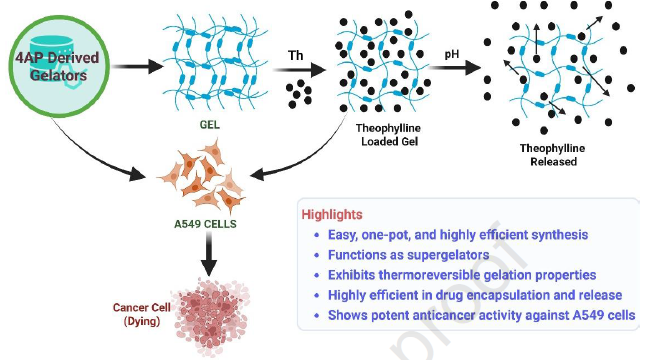
Supramolecular gels derived from low-molecular-weight gelators (LMWGs) uniquely combine features of both homogeneous and heterogeneous systems, making them highly valuable in synthetic and medicinal chemistry. Their rising prominence in cancer therapy is attributed to their excellent biocompatibility, stimuli-responsive behavior, and ability to deliver anticancer drugs directly to tumor sites-reducing systemic side effects and improving treatment efficacy. In this study, a series of fatty acid amide-based gelators (3a-3h) were synthesized through a one-step amidation of 4-aminopyridine, with alkyl chain lengths varying from C6 to C22. These gelators formed stable organo/hydrogels in DMSO/water at low minimum gelation concentrations (1% w/v), qualifying as supergelators. Longer alkyl chains enhanced gelation and thermal stability due to synergistic interactions between amide groups and hydrophobic segments. Specifically, gelators 3e and 3h demonstrated effective encapsulation of the hydrophilic drug theophylline, facilitating controlled, pH-responsive release at physiological temperature without compromising drug integrity. Cytotoxicity assays of these gelators demonstrated promising anticancer activity against A549 lung cancer cells, along with low toxicity in normal Vero cells. Furthermore, the synergistic anticancer efficacy of the theophylline loaded gel formulations (3e+Th and 3h+Th) showed enhanced potency, with IC₅₀ values of 12.89 ± 0.4 and 21.50 ± 2.8 μg/mL, respectively, highlighting their potential as advanced drug delivery systems for cancer therapy.