
730. Vitrimer Nanocomposites from Polymerization-Induced Self-Assembly
Thi H. Le, Kevin A. Stewart, Cabell B. Eades, Jared I. Bowman, Nathan B. Wei, Brent S. Sumerlin, AdvancedMaterials, (2025), DOI: 10.1002/adma.202512303
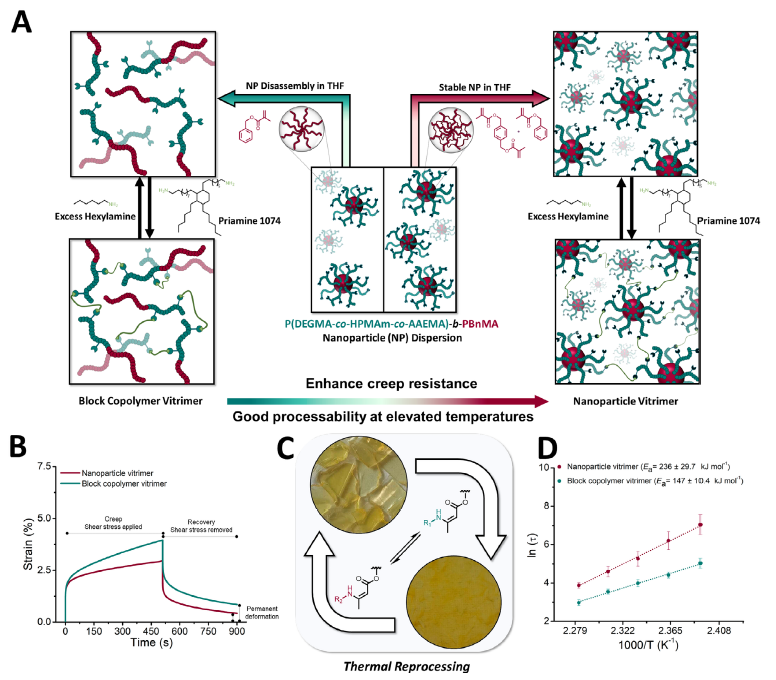
Vitrimers, a class of covalent adaptable networks (CANs), promise sustainability through recyclability and reprocessability, yet suffer from creep under prolonged stress due to dynamic bond exchange. Here, a materials design strategy is reported that integrates polymerization-induced self-assembly (PISA) to embed core-crosslinked nanoparticles within vitrimer networks, yielding hierarchical dual-crosslinked systems with a reduction of creep susceptibility by up to 90% at 150 °C yet good reprocessability at elevated temperatures (Ea = 246 kJ mol−1). These spherical nanostructures restrict chain mobility and act as rheological modifiers that can be synthetically tuned through core block length. This approach offers precise architectural control, leveraging nanoparticle phase morphology to direct bulk vitrimer properties. This study establishes a new paradigm for creep-resistant CANs and showcases how PISA can advance vitrimer performance by structurally encoding mechanical robustness and reprocessability.