
A Multidimensional Approach for 1H-11B Correlation NMR Spectroscopy
Boron is increasingly recognized for its medicinal applications [1]. Over the past two decades, significant advancements in boron organic chemistry have led to a profound impact on drug design and development [1]. These advancements have facilitated the incorporation of boron-containing functional groups into pharmaceuticals, enhancing their accessibility and practicality. Notably, several FDA-approved boron-containing compounds have been developed, including bortezomib (Velcade), tavaborole (Kerydin), ixazomib (Ninlaro), crisaborole (Eucrisa), and vaborbactam (in combination with meropenem in Vabomere) [1]. Therefore, distinguishing between various boron chemical environments is becoming critical to the development of pharmaceuticals against emerging diseases.
There are two Boron NMR active isotopes, 11B (80.1% natural abundance) has a spin of 3/2 and 10B (19.9 % natural abundance) has a spin of 3. 11B isotope offers higher sensitivity in NMR experiments owing to its higher natural abundance, a higher gyromagnetic ratio, and a lower quadrupole moment. Currently, most benchtop 11B NMR applications are restricted to only 1D NMR spectroscopy. This poses a significant limitation on the breadth of applications and structures that benchtop NMR can discern. In this application note we present HSQC and HMBC multi-dimensional 11B NMR experiments performed on a 90 MHz Spinsolve Ultra Benchtop NMR spectrometer. The results illustrate the Spinsolve’s capability to investigate boron containing compounds and their potential in boron chemistry applications.
NMR Results & Discussion
NMR techniques involving Heteronuclear Single Quantum Coherence (HSQC) are often applied to 1H-13C or 1H-15N spin pairs. Yet, HSQC applications outside of these spin pairs remain rare. For some 11B-containing compounds, a 1D 11B NMR experiment may be sufficient to discern the chemical environment around the boron center [2,3]. However, a boron cluster with overlapping boron signals may necessitate a multidimensional approach to assist in spectral assignment [2,3]. One such example is carboranes, an electron-delocalized (non-classically bonded) cluster composed of boron, carbon and hydrogen atoms [2,3]. Carboranes and their derivatives are often used in the field of antitumor research and include: boron neutron capture therapy (BNCT), BNCT/photodynamic therapy dual sensitizers, and anticancer ligands [2]. The structure of an ortho-carborane and its 1D 11B and 1H NMR spectra are shown in Figure 1.
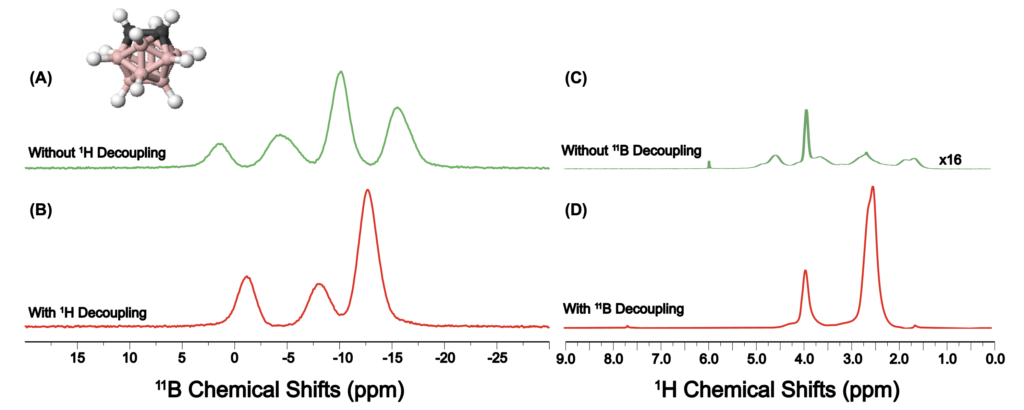
Figure 1. 11B NMR spectrum (A) without 1H decoupling and (B) with 1H decoupling. 1H NMR spectrum (C) without 11B decoupling and (D) with 11B decoupling.
Without 1H decoupling, the 1D 11B NMR spectrum shows overlapping multiplets. Similarly, for 1D 1H NMR spectrum in the absence of 11B decoupling, overlapping multiplet patterns are observed. Based on high-field NMR data, four 11B signals and four 1H NMR signals are expected when acquired under 1H and 11B decoupling [2,3]. However, due to the narrow chemical shifts dispersion of a benchtop NMR system, only three11B signals and two 1H NMR signals were observed in Figures 1B and 1C. Therefore, this illustrates a situation where a multidimensional NMR approach will prove beneficial to resolve spectral overlap. To resolve the overlap in both 1H and 11B 1D NMR spectra, a 1H-11B HSQC NMR technique is implemented and the resulting 1H-11B correlation NMR spectrum is shown in Figure 2. From the 2D HSQC 1H-11B correlation NMR spectrum, four 11B NMR signals were observed and their proposed assignments are labeled on the ortho-carborane structure [2,3]. Since the ortho-carborane molecular structure contains four unique boron sites and four distinct 11B peaks are indeed observed, this data illustrates the successful implementation of multidimensional 11B NMR spectroscopy at the benchtop NMR frequency [2,3].
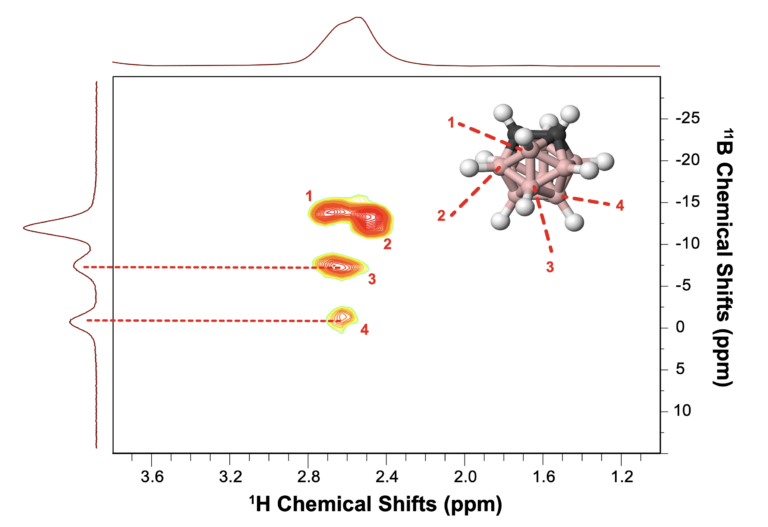
Figure 2. A 2D 1H-11B HSQC NMR spectrum of ortho-carborane was acquired in 17 minutes using 8 scans, 64 increments and a 1-second repetition delay. Echo/Anti-Echo was used for frequency discrimination in the indirect dimension.
Despite the power of the HSQC to discriminate between 1H-11B spin pairs, the HSQC experiment struggles to identify 11B sites without a directly bonded 1H. This is often the case for borate ester and other organoboron compounds. Therefore, 11B sites without a directly bonded 1H may require correlations that are derived from several bonds away. Hence, 1H-11B Heteronuclear Multiple Bonds Coherence (HMBC) will be beneficial in these situations [4]. Tetraphenyl borate (TPB) is used to illustrate the application of 1H-11B HMBC. The structure of TPB is shown in Figure 3. TPB offers an ideal case to illustrate the1H-11B HMBC sequence since the nearest 1H are four bonds aways from the 11B center. Also, the symmetry offered by the four identical ligands around the Boron center significantly reduces its quadrupole couplings, allowing for multidimensional NMR to be performed.
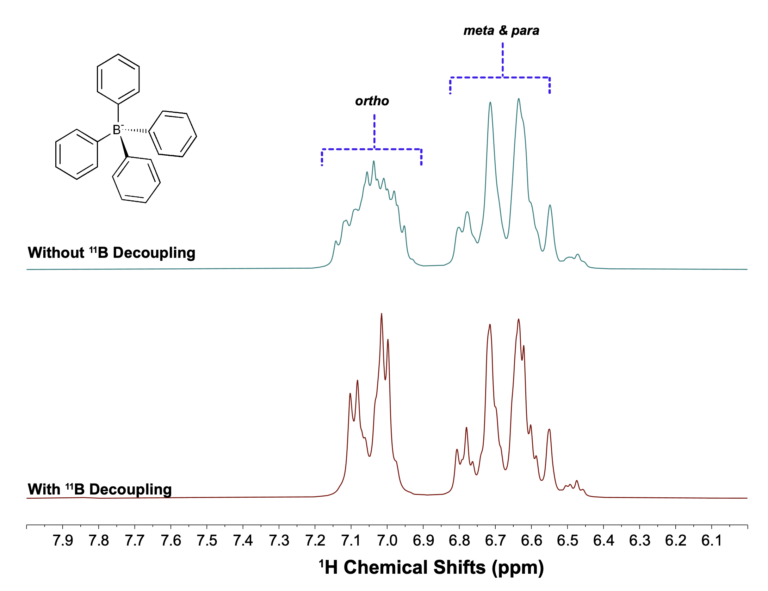
Figure 3. 1H NMR spectra acquired using a Spinsolve 90 MHz with and without 11B decoupling.
As a first step to analyze TBP, a 1D 1H experiment was recorded with and without 11B decoupling (see Fig. 3). The 11B decoupling enhances the resolution of the 1H NMR spectrum and the degree of enhancement is proportional to proximity of the protons to the 11B metal center. For example, the proton on the ortho position is hugely sensitive to the degree of 11B coupling compared to that of the meta and para position. To optimize the 1H-11B magnetization transfer for a 2D HMBC experiment, a series of HMBC experiments was acquired using different long range 1H-11B transfer times and the 1D traces extracted from the HMBC are illustrated in Figure 4. This series of spectra shows the modulation pattern as a function of the 1H-11B transfer time. Based on this series of spectra, an optimized transfer time (determine by the 1H-11B J coupling) is found and used to acquire the 2D 1H-11B HMBC NMR spectrum shown in Figure 5. This spectrum successfully provides long range correlations between 11B and 1H that are several bonds away, providing a potential avenue for spectral assignments for organoboron compounds without a directly bonded 1H-11B spin pairs.
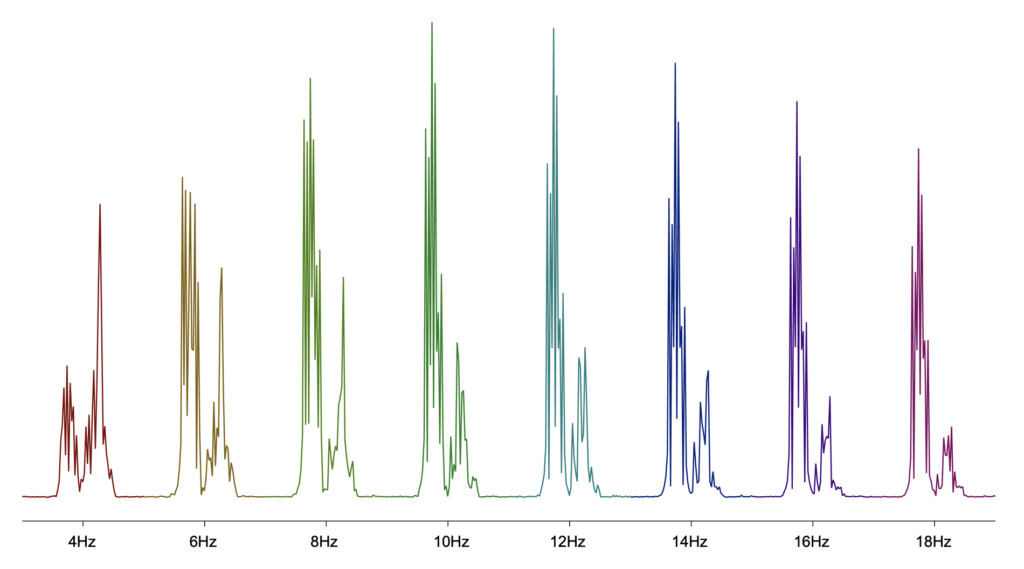
Figure 4. 1H trace projections extracted from a series of 1H-11B HMBC NMR spectra acquired for different transfer times corresponding to the long range nJBH-coupling listed under the trace. The different transfer times lead to different modulation patterns that depnd on the J coupling constant of the different groups. The optimized J-coupling was determined based on maximizing the 1H signal intensity of ortho, meta and para positions on the phenyl rings.
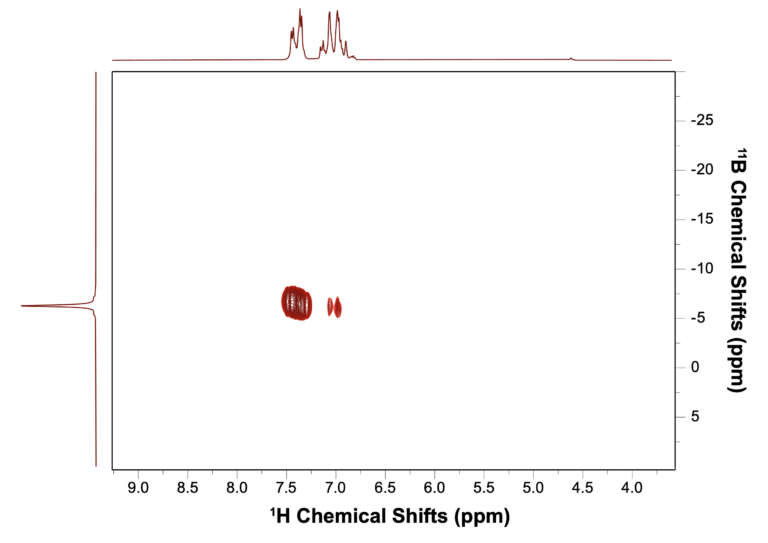
Figure 5. A 2D 1H-11B HMBC NMR spectrum was acquired using a long-range nJBH-coupling of 12 Hz. The spectrum was acquired in 5 minutes using 4 scans, 64 increments and a 1-second repetition delay.
Conclusion
This application note highlights the capability of Spinsolve spectrometers to conduct multidimensional 1H-11B NMR experiments. These 2D 1H-11B experiments, HSQC and HMBC, yielded more information than 1D experiments alone. However, these 2D experiments require a symmetric arrangement of ligands around the 11B center to reduce the quadrupolar coupling. Therefore, not all 11B compounds will benefit from these 2D experimental approaches. Nevertheless, with excellent sensitivity and the ability to automatically switch between heteronuclei for routine 2D experiments, the Spinsolve NMR instrument is equipped to deliver high-quality assignments, structural verification, and analysis of boron-containing compounds.
To read the complete App Note please Click Here
References
- Bhaskar C. Das, et al. Boron Chemicals in Drug Discovery and Development: Synthesis and Medicinal Perspective. Molecules. 2022, 27(9), 2615.
- Rüttger, F; Stalke, D; and Michael, J; Resonance and structural assignment in (car)borane clusters using 11B residual quadrupolar couplings. Chemical Communication. 2023, 59, 14657-1466.
- https://u-of-o-nmr-facility.blogspot.com/2008/04/1-h-11-b-hmqc.html (access Feb 9th, 2025).
4. Furrer, J. A comprehensive discussion of hmbc pulse sequences, part 1: The classical HMBC. Concepts in Magnetic Resonance B. 2012, 102-127.