
Benchtop NMR Coupling to Liquid Chromatography
Chemically-selective detection in Size Exclusion Chromatography Reaction
Size Exclusion Chromatography (SEC) is one of the most widely used techniques for polymer analysis. It reliably provides molar mass distributions and supports quality control, research, and industrial formulation work. However, when it comes to complex polymer systems—such as blends, block copolymers, structural isomers, or formulations with additives—conventional detectors like differential refractive index (DRI), UV, viscometry, or light scattering quickly reach their limits. They respond to concentration or mass, but they are not chemically selective. When species co-elute, their signals simply add up.
This is where benchtop NMR changes the game.
The application note introduces the coupling of an 80 MHz benchtop ¹H NMR spectrometer directly to an SEC system as an inline detector. Instead of measuring only signal intensity, the system acquires time-resolved NMR spectra during continuous flow. Each spectrum contains detailed chemical information: functional groups can be identified by their chemical shift, splitting pattern, and relative proton intensity. In other words, we do not just see how much material elutes—we see what is eluting.
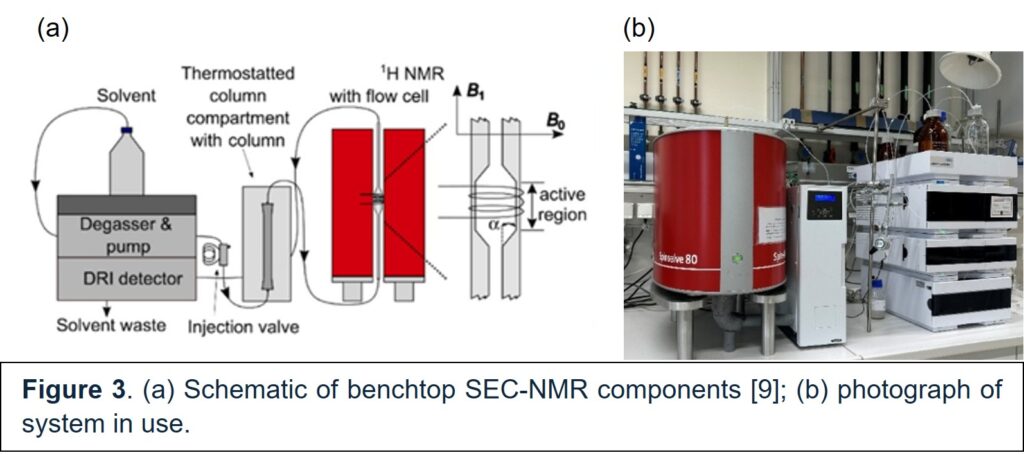
Several examples highlight the analytical power of this approach:
Polymer blends: In mixtures such as polyethylene oxide (PEO) with polypropylene oxide (PPO), or polystyrene (PS) with polymethyl methacrylate (PMMA), NMR selectively detects characteristic proton signals unique to each polymer. Even when chromatographic separation is incomplete, individual components can be monitored independently.
Block copolymers: SEC-NMR enables compositional analysis across the molar mass distribution. In diblock and triblock copolymers, unique resonances assigned to each block allow quantification of composition drift and detection of low-molar-mass contaminants—without the need for fraction collection or offline analysis.
Structural isomers: In the case of polybutadiene, different addition mechanisms (e.g., cis-1,4 vs. 1,2-addition) produce materials with distinct properties but overlapping chromatographic behavior. While UV detection is non-specific, NMR clearly distinguishes isomeric forms through unique backbone and vinyl proton signals.
Industrial formulations: For complex rubber materials and copolymer systems, SEC-NMR reveals compositional differences and identifies low-molar-mass hydrocarbon contaminants that may otherwise be difficult to characterize.
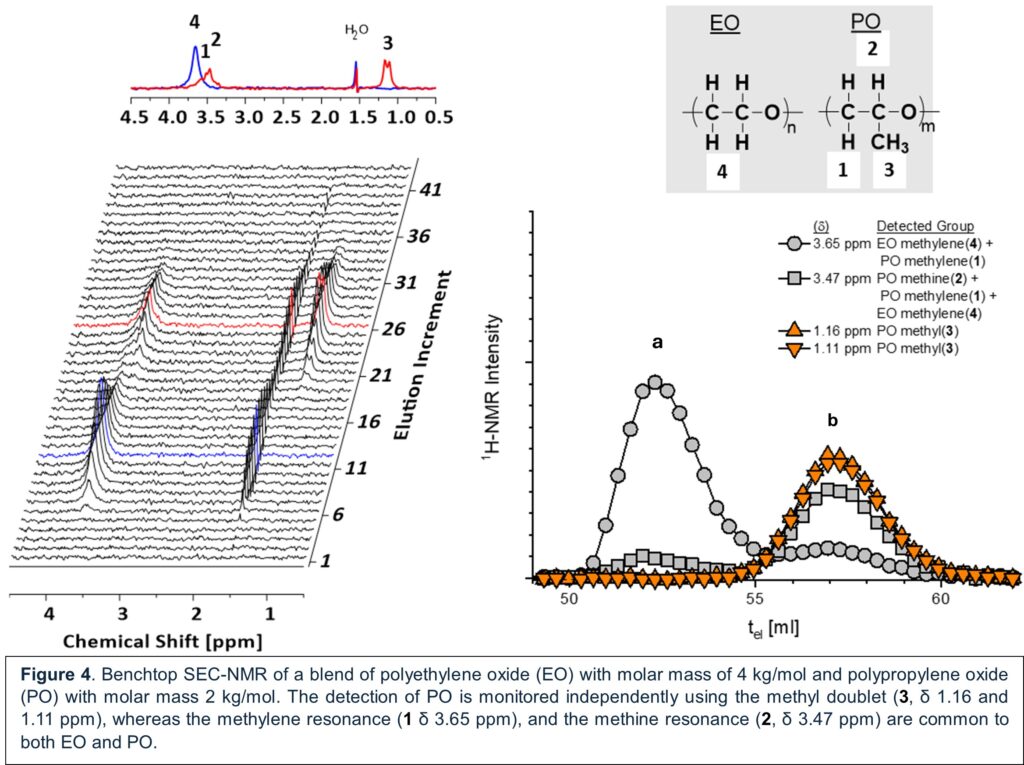
A particularly important advantage emerges when analyzing polymers that are poorly detected by traditional methods. For example, polydimethylsiloxane (PDMS) is often challenging for DRI or UV detection, yet it is readily identified by its characteristic NMR resonances. This demonstrates how chemical selectivity can solve practical detection limitations.
Overall, the coupling of SEC with benchtop NMR provides a powerful combination: chromatographic separation by size, enhanced by chemically selective structural information in real time. The result is deeper insight into composition, structure, and impurities—especially in complex polymer systems where traditional detectors fall short.
With its compact footprint, lower operating costs compared to high-field systems, and increasing methodological maturity, benchtop SEC-NMR represents a highly attractive tool for polymer researchers, analytical chemists, and industrial laboratories seeking greater selectivity and understanding in their analyses.
Authors
Michael A. Pollard, M. Gaborieau, M. Matz, J. Tratz, und M. Wilhelm.
Acknowlegdements:
The authors would like to thank T. Hofe (PSS Agilent) and J. Kolz (Magritek) for ongoing support of our research.
To read the complete App Note please Click Below