
736. Multivalorization of spent coffee grounds towards a waste free solution
Jeffrey Eiseman, Kathryn Williamson, Thomas Banker, Sriloy Dey, Xiaoying Zhao, Da Chen, Osvaldo Campanella, Yael Vodovotz, Emmanuel Hatzakis, BiomassBioenergy, (2026), 10.1016/j.biombioe.2025.108534
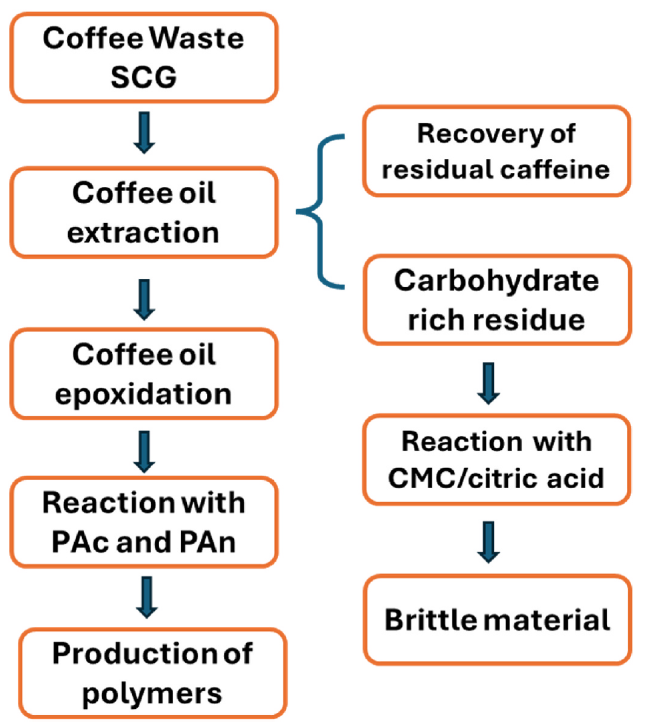
Spent coffee grounds (SCG) constitute approximately 80 % of roasted coffee bean mass and pose a significant waste management challenge. To valorize this waste, we investigated the near-complete utilization of SCG by polymerizing its lipids and defatted SCG, while isolating residual caffeine. Epoxidized lipids were polymerized, and the effects of curing agent (phthalic acid and phthalic anhydride), temperature (180 and 220 ◦C), and time (3, 6, and 24 h) on the resulting polymers’ thermal properties, rheological properties, and degree of crosslinking were investigated using a full factorial experimental design. Nuclear magnetic resonance and infrared spectroscopy were performed for structural characterization. The polymers exhibited a wide range of colors, degrees of crosslinking, thermal properties, and rheological properties. Variation in these properties were well explained by variations in curing agent, temperature, and time, suggesting that specific curing conditions can be adjusted to achieve desired characteristics suitable for a wide range of industrial applications. Additionally, the polymers with the highest degree of crosslinking exhibited a water vapor transmission rate of approximately 50 g m-2 day-1 when tested at 90 %RH, 40 ◦C and a thickness of approximately 0.6–0.7 mm. The carbohydrate-rich defatted SCG fraction was converted into a brittle, brownish material with potential application as a filler, using citric acid as a green reagent. Furthermore, pressurized fluid extraction of oil allowed the simultaneous recovery of residual caffeine. This work demonstrates the feasibility of near-complete SCG utilization through bio-polymerization, offering a sustainable approach to waste management and the development of environmentally friendly biomaterials.