
737. Structure-activity relationships for Mg-IRMOF-74-based catalysts integrating CO₂ adsorption and hydrogenation to methanol
Anna Liutkovaa, Fabio André Peixoto Estevesa,b, Anastasia Molokovac, Marianela López Romeroc, Davide Salussoc, Andrea Testinoa, Emiliya Poghosyand, Marco Ranocchiari, Chemrxiv, (2025), 10.26434/chemrxiv-2025-h3726
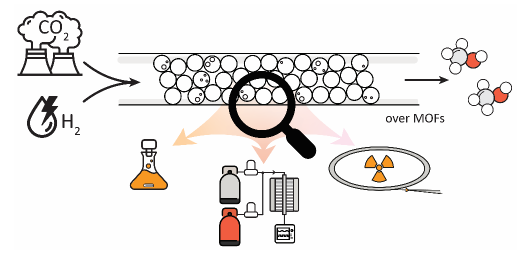
We investigated a Cu-Zn-modified Mg2(olz) catalyst for carbon dioxide (CO₂) hydrogenation to methanol under low CO₂ partial pressures, relevant to flue gas treatment. The catalyst was prepared via wet impregnation of pre-synthesized Cu-Zn nanoparticles into the metal-organic framework (MOF) under moisture-free conditions. Batch tests under mild temperatures and low CO2 concentration showed that the MOF-based system achieved higher methanol yields than a commercial Cu/ZnO/Al₂O₃ catalyst at 150 °C. Step-response experiments in a plug-flow reactor revealed that the MOF retained significant amount of CO₂ under high-pressure and dynamic conditions. Post-reaction 1H Nuclear magnetic resonance spectroscopy demonstrated retention of methanol and oxygenated intermediates in the MOF-based catalyst. X-Ray absorption spectroscopy showed partial reduction of Cu₂O-like species to Cu⁰ during reaction, while in situ X-Ray diffraction demonstrated structural stability of the MOF framework. Transmission electron microscopy revealed sheet-like MOF structures (100–150 nm) with 21 Å interplanar spacing, aligning with the theoretical pore size and indicating high surface area for diffusion and catalysis. These results indicate that Mg2(olz)-based materials can integrate CO₂ adsorption and catalytic functions, showing high methanol productivity at low temperature and maintaining stability under catalytic conditions.