
784. Autonomous Flow Reaction Optimization Guided by NMR Spectroscopy and Advanced Bayesian Optimization Algorithms
Aravind Senthil Vel, Yuliia Horbenko, Nour Elsabbagh, Burkhard Groh, Daniel Cortés-Borda, Jonathan Farjon, Patrick Giraudeau, Jean-Nicolas Dumez, Jean-Philippe Krieger, François-Xavier Felpin, ReactChemEng, (2026), 10.1039/D5RE00504C
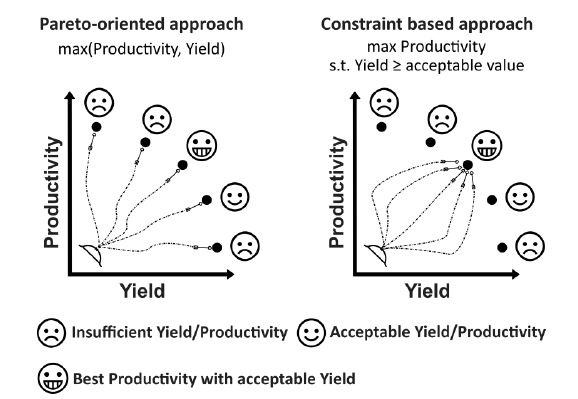
Efficient algorithmic strategies are essential for autonomous self-optimization in flow, where multiple, often conflicting, objectives must be balanced under strict experimental budgets. In this work, we compared two optimization approaches. The first is the Pareto-oriented approach, which focuses on identifying all trade-off solutions. The second is the constraint-oriented approach, where a single objective is optimised while constraining the others so that the search remains focused on the region of interest. We first evaluated both approaches in an in silico study by optimising six analytical functions and showed the advantage of the constraintoriented strategy. We then applied the two approaches in the continuous-flow synthesis of 3-phenyl-5-trifluoromethyl-1,2,4-oxadiazole monitored by compact NMR spectroscopy. In the experimental study, we used constraint within the Adaptive Boundary Constraint Bayesian Optimization, strategy we developed recently to avoid futile experiments (experiments that does not improve the current best objective value theoretically). While the Pareto approach is able to identify a diverse range of solutions, ABC-BO directed the search more efficiently towards the conditions of interest. This work demonstrates the complementarity of Paretooriented and constraint-based optimization strategies and underscore the importance of algorithm selection in autonomous chemical development.