
804. Investigation of Reaction Kinetics of the Selective Hydrogenation of a Terminal Alkyne Under Industrially Relevant Conditions With Benchtop NMR Spectroscopy
Patrick Sterner, Mery Hach, Regina Berg, Christoph Stock, Daniel Holland, Erik von Harbou, MagnResonChem, (2026), 10.1002/mrc.70091
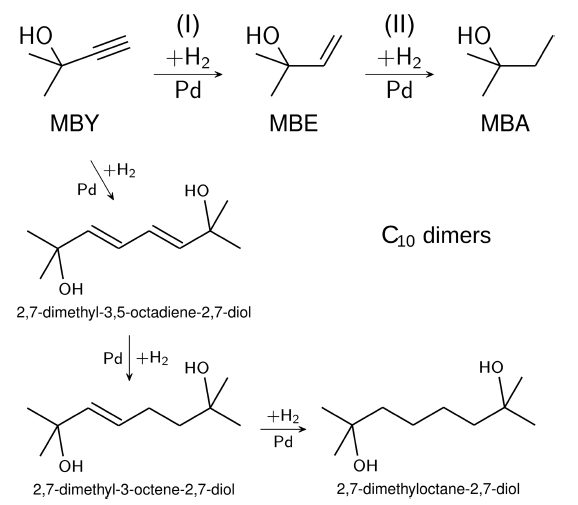
Heterogeneously catalyzed hydrogenations are pivotal in the chemical industry. Studying these reactions often demands significant experimental effort due to safety requirements, elevated pressures and temperatures, and the operational modes of traditional laboratory reactors. To address these challenges, we propose an automated, efficient, and cost-effective method for characterizing such reactions within a kinetic laboratory setting. Utilizing benchtop NMR as a noninvasive, automatable analytical tool offers advantages in terms of space and cost over high-frequency NMR, though its limited spectral resolution may restrict applicability to certain reaction systems. In this study, we investigate the hydrogenation of 2-methyl-3-butyn-2-ol (MBY) to 2-methyl-3-buten-2-ol (MBE) as a model reaction. While literature provides extensive data on the main components, the formation of side products remains inadequately explained. Conducting the reaction in a batch reactor, we assess the detection and quantification of side products. Samples withdrawn during hydrogenation are analyzed using benchtop NMR coupled with a quantum-mechanical Bayesian quantitative NMR analysis, employing component knowledge to quantify mixtures through mathematical modeling. We collect kinetic data, gaining both qualitative and quantitative insights into the reaction network at temperatures up to 80°C and a pressure of 10 bar. Our findings demonstrate that the reaction mixture's composition can be quantitatively monitored in real-time, facilitating the derivation of kinetic parameters. Despite the minor formation of various side products, we successfully quantify dimeric reaction products and evaluate process parameters influencing their formation. The integration of a reactor, online benchtop NMR, and advanced qNMR data analysis yields high-quality results essential for process optimization.