
721. Validation of benchtop NMR-based quantification of saturated, monounsaturated, and polyunsaturated fatty acids in edible oils
Umrbek Mavlanov, Sardorbek Atajanov, Sharofiddin Nuriddinov, Sardorjon Shukurov Salimovich, Soyibjon Bozorov, Tomasz Pawel Czaja, Bekzod Khakimov, Chemrxiv, (2025), DOI: 10.26434/chemrxiv-2025-dmfc8
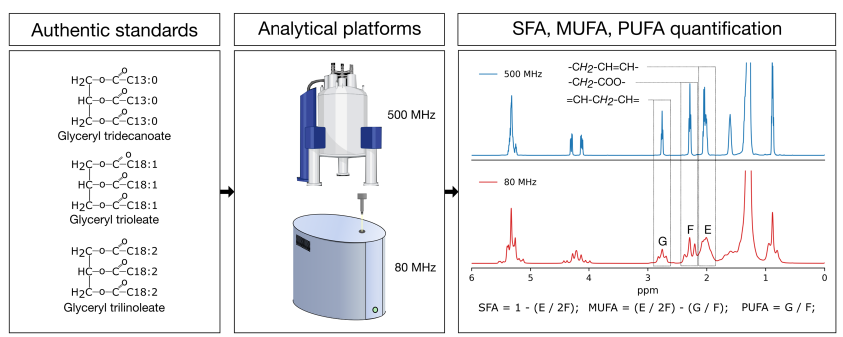
Proton nuclear magnetic resonance (1H NMR) spectroscopy offers rapid quantification of saturated (SFA), monounsaturated (MUFA), and polyunsaturated (PUFA) fatty acids in oils. While high-field NMR has been widely applied, its high operational costs limit accessibility. In contrast, benchtop NMR provides a more affordable and user-friendly option for oil analysis. However, its lower sensitivity and resolution have led methods to rely on chemometric modeling, requiring spectra acquired under identical conditions as the reference model, thereby restricting applicability. In this study, we validated for the first time a benchtop (80 MHz) 1H NMR method for direct quantification of SFA, MUFA, and PUFA in oils using integration of characteristic resonances, enabling a model-free and reproducible approach. To our knowledge, this is the first benchtop NMR validation of SFA, MUFA, and PUFA resonances using authentic triglyceride standards, glyceryl tridecanoate, glyceryl trioleate, and glyceryl trilinoleate, respectively. Binary and ternary mixtures and spiked sunflower oils prepared from these standards enabled the first direct comparison of fatty-acid quantification between benchtop and high-field (500 MHz) NMR. Our optimized workflow enabled both platforms to deliver comparable accuracy and reproducibility. This validated, model-free approach provides reliable fatty acid profiling, accelerating oil analysis in research and quality control laboratories.