
724. Exploring the Competitive Adsorption of Water−Ethanol Mixtures within Mesoporous Silicas
J A. Ward-Williams, L. C. M. Rozing, M. Appel, M. D. Mantle, A. J. Sederman, L. F. Gladden, JPhysChemC, (2025), DOI: 10.1021/acs.jpcc.5c03093
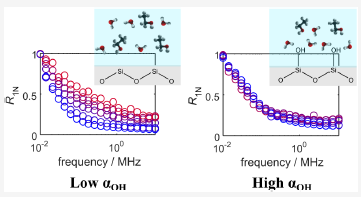
Understanding competitive adsorption at solid−fluid interfaces is key to controlling the properties of a wide range of sorptive and catalytic materials. Here, we apply fixed field (T1-T2) and fast field cycling (FFC) NMR relaxation analysis to probe the microphase separation and liquid structuring that occurs in mixtures of water and ethanol imbibed within a series of well-controlled silica materials with pore diameters ranging from 5 to 27 nm. Clear differences were observed between the relaxation behavior of liquid mixtures imbibed within the as-received small-pore silicas (≤14 nm) and the larger-pore silicas (≥20 nm), with the former showing a mixed water−ethanol surface phase that was influenced by the intraparticle compositions and the latter showing a strong microphase separation and an adsorbed layer that was dominated by water regardless of the intrapellet composition. The surface hydroxyl density of the small-pore silicas (≤2.0 nm−2) was much lower than that of the large-pore silicas (≥5.3 nm−2). Surface modifications of the smallest (5 nm) and largest (27 nm) pore silicas were carried out through rehydroxylation and silylation procedures, respectively, to differentiate the effects of surface chemistry and pore size. Rehydroxylation of the 5 nm pore silica caused a microphase separation of the confined fluids, while the silylated 27 nm pore silica showed no evidence of competitive adsorption. These results suggest that surface chemistry, particularly the surface hydroxyl density, was the dominant factor defining competitive adsorption and phase behavior within the silica pores for the range of pore sizes studied. These results show that magnetic resonance relaxometry methods provide a powerful approach to characterize competitive adsorption processes occurring within porous media, and hence facilitate the design and selection of porous materials for specific applications.