
726. Analyzing the Chemical Stability of Bio-Based Polyamide Resins via Solubility Parameters, NMR Spectroscopy and Capillary Electrophoresis
Kash A. Bhullar, Richard Wuhrer, Patrice Castignolles, Marianne Gaborieau, MacroChemistryPhysics, (2025), DOI: 10.1002/macp.202500210
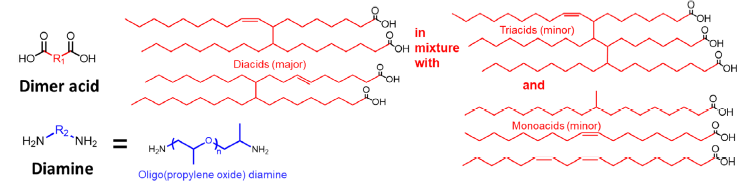
Chemical stability is a key property for polymeric hot-melt adhesives (HMAs) used in industrial settings. The chemical stability of an HMA and its polyamide base resin (obtained from bio-based dimer acids) is assessed after immersion in various solvents. Visual observation and gravimetry show that they resist alkaline conditions better than acidic conditions and are susceptible to dispersion in organic solvents. The organic solvents’ impact can be predicted using Hansen parameters. Infrared (FTIR) and solid-state NMR spectroscopies confirm the degradation of the polyamide resins and HMA at the molecular level. Solution-state NMR allows the identification of the type of degradation, such as aromatic substitution. Aromatics and vinylics (from the dimer acid) are quantified with solution-state NMR, including benchtop NMR. The precision of the quantification does not depend on the sensitivity of the instrument but rather on the user-dependent data treatment. The degradation occurs via amide hydrolysis, leading to chain scission, without imide formation. Degradation does not affect the relative amount of vinylics but surprisingly affects that of the aromatics. Free-solution capillary electrophoresis (CE) allows the detection and separation of the most hydrophilic degradation products, including monomers, during the degradation in highly acidic or alkaline conditions without any sample preparation.