
728. Biosynthesis and characterization of a novel polyhydroxyalkanoate terpolymer containing 2-methyl-4-hydroxybutyrate produced by the thermophilic bacterium Aneurinibacillus sp.
Veronika Řeháková, Iva Buchtíková, Petr Sedláček, Klára Tušlová, Lucy Vojtová, Martin Koller, Michal Kalina, Stanislav Obruča, IntJBioMacromol, (2025), DOI: 10.1016/j.ijbiomac.2025.148042
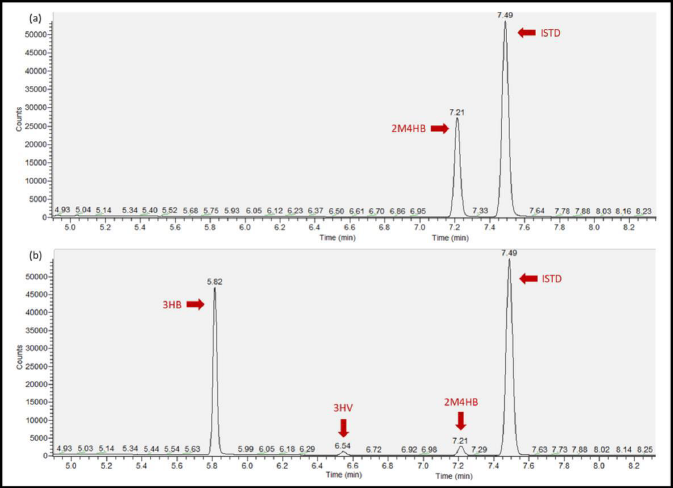
The increasing environmental burden of plastic pollution has intensified the search for sustainable alternatives, such as polyhydroxyalkanoates (PHA). In this study, we report the biosynthesis and characterization of a novel PHA terpolymer containing 2-methyl-4-hydroxybutyrate (2M4HB), produced by the thermophilic Gram-positive bacterium Aneurinibacillus sp. AFN2. Incorporation of α-carbon methylated monomers, such as 2M4HB, alters the thermal and material properties of PHAs, resulting in more amorphous and flexible polymers compared to conventional PHA. The strain was cultivated on α-methyl-γ-butyrolactone (AMGBL), either as the sole carbon source or in combination with glucose. Under optimized conditions (4 g/L AMGBL and 4 g/L glucose), the bacterium synthesized poly(3-hydroxybutyrate-co-3-hydroxyvalerate-co-2-methyl-4-hydroxybutyrate) containing up to 11 mol% of 2M4HB. The terpolymer composition was confirmed by gas chromatography and 1H nuclear magnetic resonance spectroscopy. Material characterization by size-exclusion chromatography, coupled with multi-angle light scattering detection, Fourier-transform infrared spectroscopy, and differential scanning calorimetry, revealed that incorporation of 2M4HB markedly influenced the polymer’s properties. Higher 2M4HB content resulted in lower molecular weight, decreased melting temperature and enthalpy, and enhanced amorphous character. These findings highlight the exceptional metabolic versatility of Aneurinibacillus sp. AFN2, enabling direct incorporation of branched lactone-derived monomers without prior chemical hydrolysis. This work positions thermophilic members of the genus Aneurinibacillus as a promising platform for the sustainable production of PHA copolymers with tunable physicochemical properties.