
732. Absolute Temperature Mapping Using Chiral Terbium Parashift Complexes for MRI Thermometry
Carlson Alexander, Huishan Li, Peter Harvey, Galina E. Pavlovskaya, Nicola J. Rogers, David Parker, ChemBiomedImaging, (2025), DOI: 10.1021/cbmi.5c00144
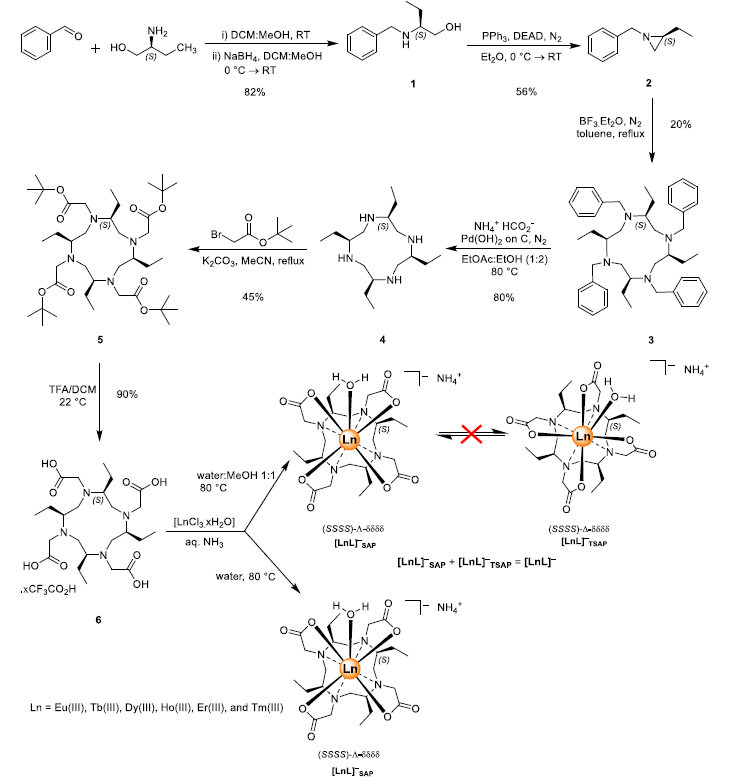
A noninvasive imaging approach for absolute temperature mapping has been demonstrated using Parashift molecular imaging probes for MRI. Temperature readout is achieved by exploiting the chemical shift difference between the CH2 SAP and CH3 TSAP resonances of two nonexchanging (SAP and TSAP) isomers of a single chiral lanthanide complex, without the need for external calibration. Variable-temperature NMR analyses of [LnL]− complexes - derived from S-tetraethyl cyclen - identified the CH2 SAP and CH3 TSAP resonances as optimal reporters for Parashift spectral imaging, owing to their large hyperfine shifts and narrow spectral line widths. Temperature coefficients as high as 0.46 ppm K−1 were observed for individual resonances of the square antiprismatic (SAP) isomer of [DyL]−, while normalized coefficients (temperature shift per unit line width) reached 1.7 K−1 for [TmL]−. Among the complexes studied, [TbL]− emerged as the most suitable for temperature imaging, considering the overall temperature sensitivity of the chemical shift difference. In phantom imaging experiments at 9.4 T (preclinical field) temperature variations across phantom tubes were successfully mapped with a resolution of 0.1 K.