
744. 30-Channel Microcoil System for High-Throughput Metabolic Flux Analysis Using Hyperpolarized ¹³C NMR Spectroscopy
Nichlas Vous Christensen, Sissel Ellemose Liboriussen, Juan D. Sanchez-Heredia, Esben Søvsø Szocska Hansen, Christoffer Laustsen, Lotte Bonde Bertelsen, NMRBiomedicine, (2025), 10.1002/nbm.70174
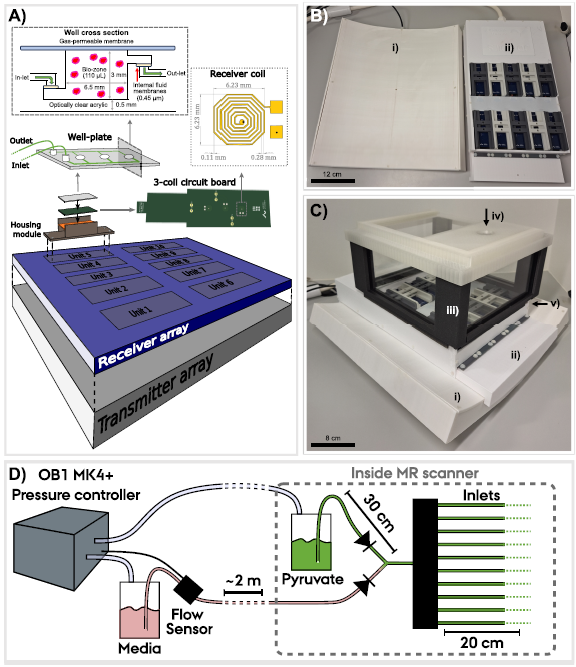
Hyperpolarized (HP) carbon-13 labeled compounds have significantly advanced metabolic research, enabling real-time, non-invasive tracking of metabolic processes in vivo and ex vivo. These techniques are particularly valuable for studying diseases characterized by altered metabolism, such as cancer, but their high cost and technical complexity limit broader adoption. A critical need exists for cost-effective, high-throughput methods to maximize the utility of these tracers in translational research. In this study, we present a 30-channel microcoil receiver array that enables simultaneous metabolic flux measurements across 30 samples using a single HP dissolution. This system represents a significant increase in throughput compared to previous setups. Using a single dissolution of HP [1-13C] pyruvate, we demonstrate the system's ability to detect significant changes in pyruvate-to- lactate conversion in acute myeloblastic leukemia ML-1 cells treated with 2-deoxy-d-glucose. This was achieved with high statistical power (p < 0.001), despite inter-plate variability in perfusion rates of HP pyruvate. This work establishes a new benchmark for high-throughput HP technologies, achieving high statistical power per pyruvate dissolution. By addressing key limitations and optimizing current designs, this technology holds potential in translational metabolic research, particularly in resource-intensive applications such as drug screening and disease modeling. Furthermore, the modular design of the microcoil array is adaptable for a variety of sample types, including tissues, organoids, and patient-derived models. This versatility positions the system as a promising tool for translational research in metabolic diseases, extending beyond oncology to conditions such as diabetes, neurodegeneration, and cardiovascular disorders.