
746. Increasing Infusion Times of Hyperpolarized [1-¹³C]Pyruvate in a Mouse Brain Maintain Lactate Generation and Approach Pseudo-Steady State Metabolism
Paola Porcari, Vesselin Miloushev, Saket Patel, Thasin Peyear, Marjan Berishaj, Kayvan R. Keshari, MagnResonMed, (2025), 10.1002/mrm.70175
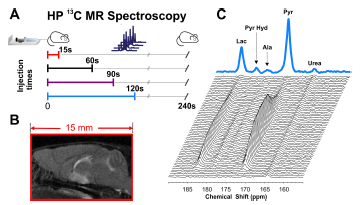
Purpose: To investigate whether varying delivery times of hyperpolarized [1-13C]pyruvate, enabled by the increased apparent T1 dissolved in deuterium oxide (D2O), affects the observed kinetics of glycolytic brain metabolism in vivo.
Methods: Eighteen healthy mice were injected with 300 μL of hyperpolarized [1-13C]pyruvate dissolved in D2O at increasing injection times (15 s, 60s, 90s, 120 s). After collecting T2-weighted scans, slab dynamic 13C MRS data were acquired. Time-course curves of [1-13C]pyruvate, [1-13C]lactate and [1-13C]lactate/total carbon ratio were calculated. Mean full-width-half-maximum (FWHM) and area-under-curve (AUC) values were compared across injection times. A simplified one-compartment model of pyruvate metabolism was fit using the conversion rate constant (kPL) and effective lactate decay rate (R1eff). Dynamic EPSI images, acquired using an injection time of 15 s and 60 s for comparison
Results: The mean FWHM values of the time-course curves of [1-13C]pyruvate and [1-13C]lactate showed a significant increase (p<0.01) with increasing injection times, while no statistical significance was found across the AUC values. The time-course curves of lactate/total carbon ratio showed elongated plateaus with increased injection times. Kinetic modeling showed good agreement between fitted and acquired lactate data, with AUC of normalized lactate profile remaining constant across infusion times. Dynamic EPSI images acquired with a longer infusion time (60 s) showed the ability to monitor brain metabolism as it approached pseudo-steady state.
Conclusions: Increased delivery times of hyperpolarized [1-13C]pyruvate dissolved in D2O approaches pseudo-steady state metabolism in vivo and allowing for the potential to cater new acquisition and reconstruction approaches for enhanced imaging.