
753. Multidimensional pH-Temperature Mapping of SABRE-SHEATH ¹³C Hyperpolarization of [1-¹³C]Pyruvate
Isaiah Adelabu, Joseph Gyesi, Md Raduanul H. Chowdhury, Clementinah Oladun, Shiraz Nantogma, Grant Foren, Anna Samoilenko, Jessica Ettedgui, Rolf E. Swenson, Murali C. Krishna, Patrick TomHon, Thomas Theis, Henri de Maissin, Andreas B. Schmidt, Boyd M. Goodson, Sydney Scofield, Lukas Stilgenbauer, Marianna Sadagurski, and Eduard Y. Chekmenev, JChemPhysB, (2025), 10.1021/acs.jpcb.5c05015
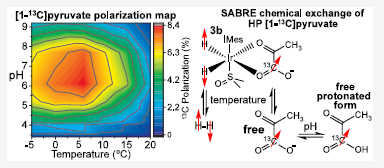
Hyperpolarized [1-13C]pyruvate has emerged as a next-generation molecular probe for in vivo metabolic flux imaging in deep tissue. This molecular contrast agent is now under evaluation in over 50 clinical trials, according to clinicaltrials.gov. Hyperpolarized [1-13C]pyruvate is produced through dissolution dynamic nuclear polarization (d-DNP) for clinical research use. This remarkable hyperpolarization technique is regarded as expensive (>$2 M equipment cost) and slow (1 h production). One alternative hyperpolarization technique called Signal Amplification By Reversible Exchange (SABRE) in SHield Enables Alignment Transfer to Heteronuclei (SABRE-SHEATH) has recently garnered substantial attention for production of hyperpolarized [1-13C]pyruvate quickly (in 1 min) and inexpensively (<$20K equipment). It has been successfully demonstrated in vivo for metabolic imaging of cancer. This technique relies on the simultaneous chemical exchange of parahydrogen, acting as a source of nuclear spin order, and [1-13C]pyruvate on a Ir-IMes polarization transfer catalyst at ∼0.4 μm magnetic field. The SABRE catalyst forms two kinds of complexes with parahydrogen-derived hydrides, pyruvate, and dimethyl sulfoxide, acting as a critically important coligand; however, only the complex that binds pyruvate in an equatorial position can release hyperpolarized [1-13C]pyruvate into the solution to enable bulk HP [1-13C]pyruvate production for use in molecular imaging and other applications. Here, we investigate the interplay of pH and temperature with the SABRE-SHEATH hyperpolarization of [1-13C]pyruvate. Temperature and pH modulate this process in remarkable and complementary ways, greatly affecting pyruvate exchange and 13C relaxation dynamics. The overall process is optimal at pH (methanol) of 6.5−7.7 and a temperature of 6 °C: indeed, the catalyst-bound pyruvate exhibits high 13C polarization levels in excess of 25%. The 13C polarization results are additionally supported by 13C relaxation dynamics at a polarization field of 0.4