
761. Low-resistivity nanocomposite electrodes based on carbon nanotubes and a water- and organic-solvent-soluble PEDOT derivative for high-performance actuators
Naohiro Terasawa, Mutsuo Tanaka, SensorsActuators, (2026), 10.1016/j.sna.2025.117385
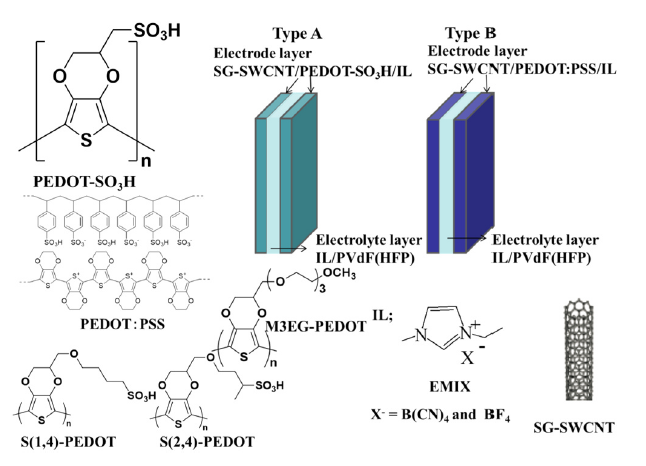
Poly(3,4-ethylenedioxythiophene):poly(4-styrenesulfonate) (PEDOT:PSS) is widely available as an aqueous dispersion of colloidal particles; however, it has several technical limitations, including poor solubility in water and organic solvents, which hinder processability and device performance. This study synthesized a novel PEDOT derivative bearing a methylsulfonic acid moiety, poly[(2,3-dihydrothieno[3,4-b][1,4]dioxin-2-yl)methylsulfonic acid] (PEDOT-SO3H), which is highly soluble in aqueous and organic media. The performance of PEDOT-SO3H was investigated by fabricating nanocomposite electrodes and actuators composed of highly conductive single-walled carbon nanotubes synthesized via the super-growth (SG) method (SG-SWCNTs), PEDOT-SO3H, and one of two ionic liquids (ILs). Thus, the underlying mechanisms were observed and determined to be a combination of electric double-layer and faradaic capacitance. The electromechanical and electrochemical properties of the SG-SWCNT/PEDOT-SO3H/IL composites were compared with those of previously developed SG-SWCNT/PEDOT:PSS/IL and SG-SWCNT/IL composites. The PEDOT-SO3H-based electrode demonstrated significantly lower volume and surface resistivity and a higher specific capacitance than the PEDOT:PSS-based electrode. Furthermore, the PEDOT-SO3H-based actuators showed greater maximum strain than PEDOT:PSS-based actuators. These results indicate that PEDOT-SO3H can improve the performance of actuators. The frequency-dependent strain behavior was accurately predicted using a kinetic model based on double-layer charging, which confirmed that the actuator operated via a combination of double-layer and faradaic capacitance mechanisms. In conclusion, PEDOT-SO3H offers superior conductivity, capacitance, and strain performance compared with PEDOT:PSS, making it a promising material for next-generation soft actuators, particularly in biomedical and flexible electronic applications.