
782. Unprocessed Aloe Vera Gel as Quasi-Solid-State Electrolyte for High-Performance Organic Electrochemical Transistors
Getnet Kassahun, Reem El Attar, Mamatimin Abbas, Damien Thuau, AppliedMatInterf, (2026), 10.1021/acsami.5c21711
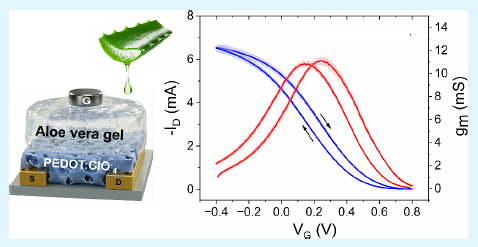
Organic electrochemical transistors (OECTs) require electrolytes that unite high ionic conductivity and mechanical compliance with intrinsic biocompatibility and sustainability, a combination difficult to achieve by conventional aqueous liquids, ionic liquids, or synthetic hydrogels. Here, we demonstrate that a natural aloe vera gel can serve as a single-component quasi-solid electrolyte for high-performance OECTs, leveraging its native minerals (Ca2+, K+, Na+, Mg2+ ions) and high-water content. Rheological tests confirm a soft, viscoelastic gel network, and electrical measurements reveal an ionic conductivity of ∼6.1 mS/cm with interfacial capacitance of ∼58.5 μF/cm2. In OECT devices, the aloe electrolyte yields high-performance transistors: peak transconductance of ∼11 mS and ON-current of ∼6.5 mA, comparable to conventional phosphate buffered saline (PBS) gating. Transient analysis confirmed rapid switching kinetics, with high stability demonstrated by >96% drain current retention after 100 cycles. These results establish natural aloe vera gel as a unique, non-diffusion-limited, inherently biocompatible and biodegradable gating medium, overturning expectations of slow solid-state performance and charting a path toward truly sustainable (“green”) bioelectronic systems.