
792. Comprehensive Study of 3D Liquid Flow Fields in Additive Manufactured Structures for SMART Reactors Using Large-Scale Vertical Magnetic Resonance Imaging and Computational Fluid Dynamics
Timo Merbach, Muhammad Adrian, Christoph Wigger, Selma Iraqi Houssaini, Benedict Bayer, Artyom Tsanda, Serhan Acikgöz, Christian Weiland, Felix Kexel, Dirk Herzog, Marko Hoffmann, Ingomar Kelbassae, Tobias Knopp, Alexander Penn, Michael Schlüter, Arxiv, (2026), 10.48550/arXiv.2602.09750
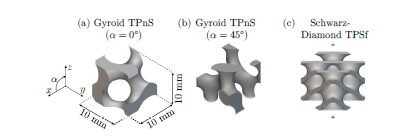
Triply Periodic Minimal Surface (TPMS) structures have emerged as a new class of porous materials with variable geometries and favourable transport properties, making them promising for reactor internals in chemical engineering. However, experimental data on internal TPMS flow behaviour are still limited. To address this gap, the flow behaviour in additively manufactured TPMS structures is analysed using three-dimensional Magnetic Resonance Imaging (MRI) velocimetry in a large-bore vertical 3 T MRI system, in cylin-drical columns of 38 mm diameter and Reynolds numbers between 50 and 300. Three different TPMS geometries are investigated, and consistency between Computational Fluid Dynamics (CFD) simulations and experimentally measured MRI velocity fields is established through cross-validation. The MRI system provides fully three-dimensional velocity fields with a divergence deviation below 6 %. MRI revealed distinct flow features: the Gyroid TPnS exhibited pronounced channelling, while the Schwarz-Diamond TPSf showed merge-split behaviour, achieving a 46 % increase in lateral mixing compared to the Gyroid TPnS structures. Numerical simulations reproduce the flow features and show agreement with the MRI data. The combined methodology demonstrates the suitability of MRI velocimetry for the experimental validation of CFD simulations and establishes a robust foundation for future studies of heat and mass transfer, as well as reactive flow, in structured reactor systems.