
795. Machine Learning-Guided Optimization of SABRE Hyperpolarization for α‑Ketoglutarate in Acetone−Water
Erica Curran, Sina Sadeghi, Stephen J. McBride, Karl Mattsson, Megan Pike, Rielly J. Harrison, Mustapha B. Abdulmojeed, Franziska Theiss, Patrick TomHon, Eduard Y. Chekmenev, Milad Abolhasani, Thomas Theis, AnalChem, (2026), 10.1021/acs.analchem.5c05859
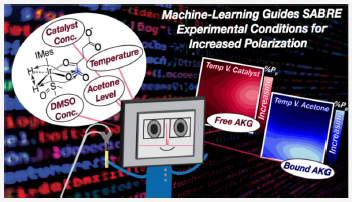
Signal amplification by reversible exchange (SABRE) is a hyperpolarization method that polarizes target nuclei of metabolites quickly and rapidly. Recent SABRE advances, including Ace-SABRE, yield biocompatible, aqueous solutions of hyperpolarized markers for metabolic monitoring. Building on recent advancements, expanding the substrate scope of Ace-SABRE is desirable. However, SABRE polarization is sensitive to many different parameters; therefore, traditional optimization approaches are experimentally time-consuming. In this proof-of-concept application of machine learning (ML), Bayesian optimization (BO) is used for four important input parameters to model the complex SABRE dynamics while saving experimental time. The presented ML model also provides chemical insights that enable predictions of sample compositions for increased polarization levels. In this work, we transition from an original average free polarization of p = ∼0.90% to a maximum observed free polarization of p = ∼6.6% for 1-13C alpha-ketoglutarate (AKG) with 13C at natural abundance, utilizing both direct outputs as well as chemical insights revealed by the ML model.