
798. Hyperpolarized [U‑²H, 2-¹³C]Fructose Distinguishes Direct Hepatic Gluconeogenesis Through Fructose-1-Phosphate Production in Fed and Fasted States
Celia Martínez de la Torre, Grace Figlioli, Mario C. Chang, Quinlan Cullen, Kayvan R. Keshari, ACSChemicalBiology, (2026), 10.1021/acschembio.5c00980
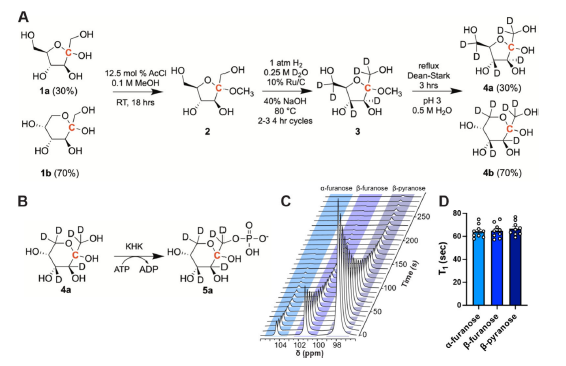
Hepatic fructose utilization depends on ketohexokinase mediated phosphorylation to generate fructose-1-phosphate and commit fructose carbons to additional metabolic steps. Since dysregulated fructose metabolism has been directly connected to the onset and progression of liver disease and cancer, there is considerable interest in identifying the contributions of fructose carbons in bioenergetic pathways. An essential technology for assessing fructose utilization has been the application of isotopically labeled fructose and magnetic resonance with the development of 13C hyperpolarized imaging with [2-13C]fructose allowing for in vivo assessments. While hyperpolarized imaging of [2-13C]fructose has achieved remarkable success in the detection of cancer metabolism, this approach has yet to be utilized to assess fed and fasted states in healthy livers. By challenging mice with a 6 h fast, we demonstrate that hyperpolarized [U-2H, 2-13C]fructose in vivo spectroscopy can clearly distinguish direct hepatic gluconeogenesis. Comprehensively, this work aims to establish a foundational methodology for the assessment of hepatic metabolism in vivo.