
19F - 13C spin-pairs correlations on benchtop NMR via HSQC and HMBC
Introduction
The ¹⁹F-¹³C bond is among the strongest in organic chemistry and is frequently employed as a functional modification to enhance ligand affinity or enable evasion of detection in designer drugs [1,2]. With the growing incorporation of ¹⁹F into modern pharmaceuticals, the ability to accurately identify and assign ¹⁹F ¹³C spin pairs has become increasingly important for reliable structure elucidation and comprehensive molecular characterization [1,2]. Although ¹⁹F exhibits a much broader chemical shift dispersion than ¹H, 19F-13C correlation experiments like HSQC and HMBC can be easily implemented on benchtop NMR spectrometers. As an NMR active nucleus, ¹⁹F offers exceptional sensitivity—approximately 94% that of ¹H in theory—and, with 100% natural abundance, it is second only to 1H in overall NMR sensitivity. Therefore, this makes 19F-13C correlation based on 19F inverse detection an ideal choice [1,2].
NMR Results & Discussion
To illustrate the performance of benchtop NMR to detect 19F-13C couplings, an Octafluorotoluene sample was used as proof of concept. This molecule contains a broad range of 19F resonance from aromatic to aliphatic. A 19F-13C HSQC NMR of Octafluorotoluene is shown in Figure 1.
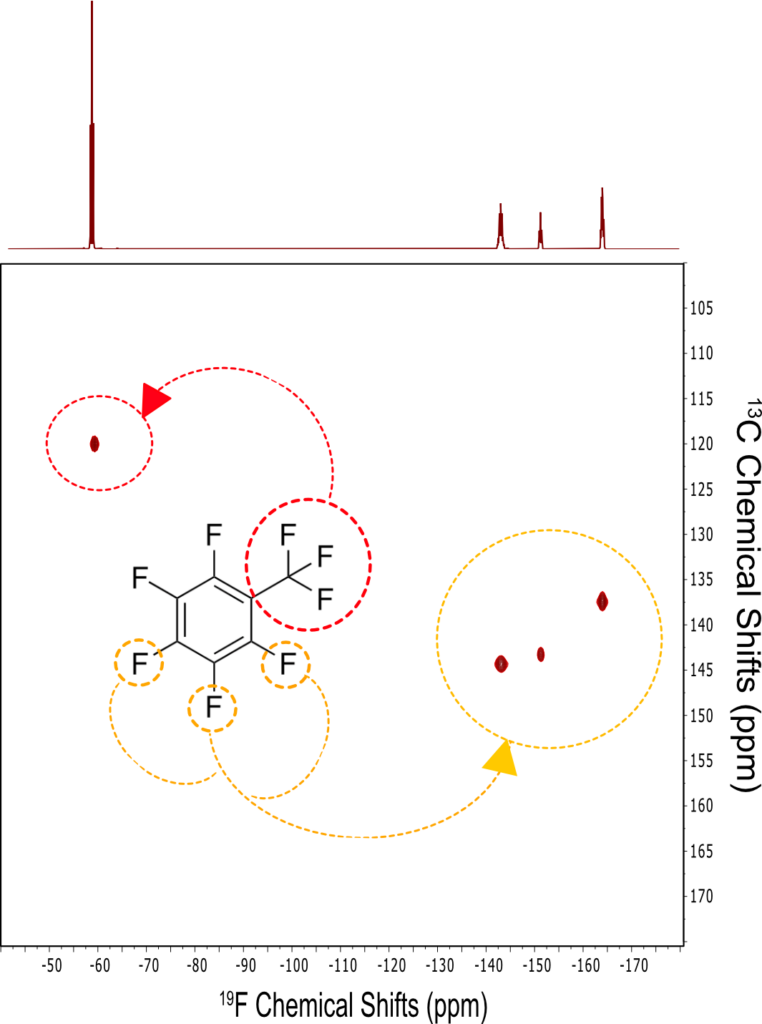
Figure 1. 2D 19F-13C HSQC spectrum of Octafluorotoluene acquired using 4 scans and 128 complex points in the indirect dimension with 1s recycle delay. Frequency discrimination in the indirect dimension is accomplished through echo/anti-echo protocol.
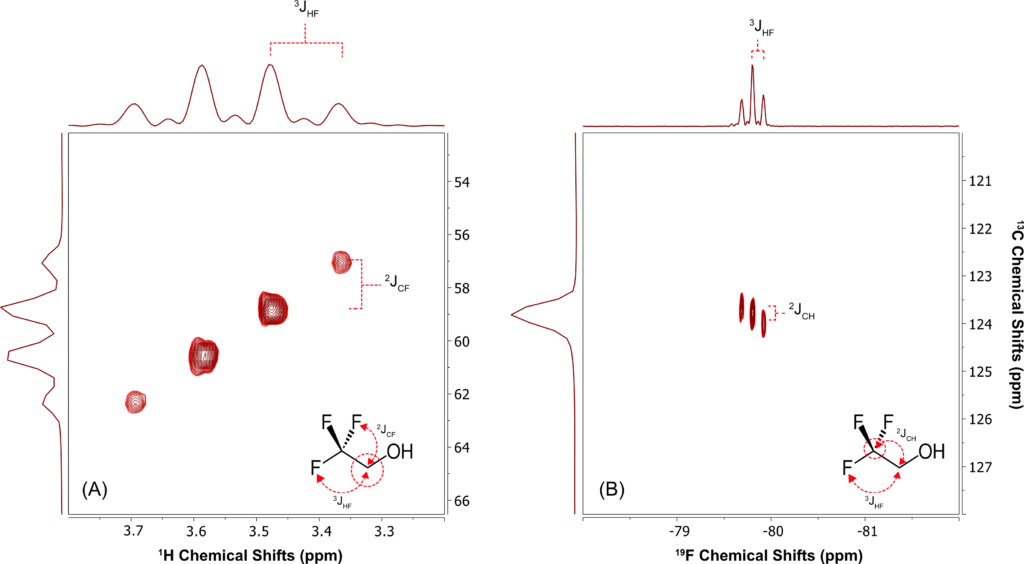
Figure 2 (A) 1H-13C HSQC and (B) 19F-13C HSQC of neat trifluoroethanol.
In the case of the 1H-13C HSQC shown in Figure 2A, several overlapping coupling patterns are observed. Due to the proximity of the protonated carbon to the 19F nuclei, it experiences both a two-bond 2JCF coupling and a three-bond 3JHF coupling. Importantly, since 19F decoupling is not applied during the incremental delay period, the carbon signal evolves under both the 13C chemical shift and the two-bond 2JCF coupling. As a result, this produces a quartet-like pattern. Interestingly, during the acquisition of the direct dimension, only 13C decoupling is applied such that the 1H will evolve according to the 3JHF coupling in addition to its chemical shift evolution, showing quartet pattern as well.
In comparison with the 19F-13C HSQC shown in Figure 2B, the fluorinated carbon experiences both a two-bond 2JCH coupling and a three-bond 3JHF coupling. Because the two-bond 2JCH coupling is small relative to the linewidth of the 13C resonance in the indirect dimension, the signal appears as a singlet. However, in the direct dimension, where only 13C decoupling is applied, the 19F nucleus evolves according to both the 3JHF coupling and the 19F chemical shift, resulting in a triplet pattern in the direct dimension. It is important to note that the observed shearing arises from the 2JCH coupling interaction during the 13C chemical shift evolution period.
Heteronuclear J-couplings provide valuable information for determining the conformation of a compound [3,4]. With a carefully designed experiment, these couplings can be measured within a single experiment. To illustrate this, a 19F-13C HMBC is used to measure the various heteronuclear J-coupling in Trifluoroethanol. Since only 19F decoupling is applied in the indirect dimension, 1H-13C J-coupling can be clearly resolved, allowing you to measure the 1JCH. In contrast, the direct dimension is acquired using no decoupling. Therefore, the direct 19F dimension can be used to measure all the JCF and JHF couplings in the molecules [4].
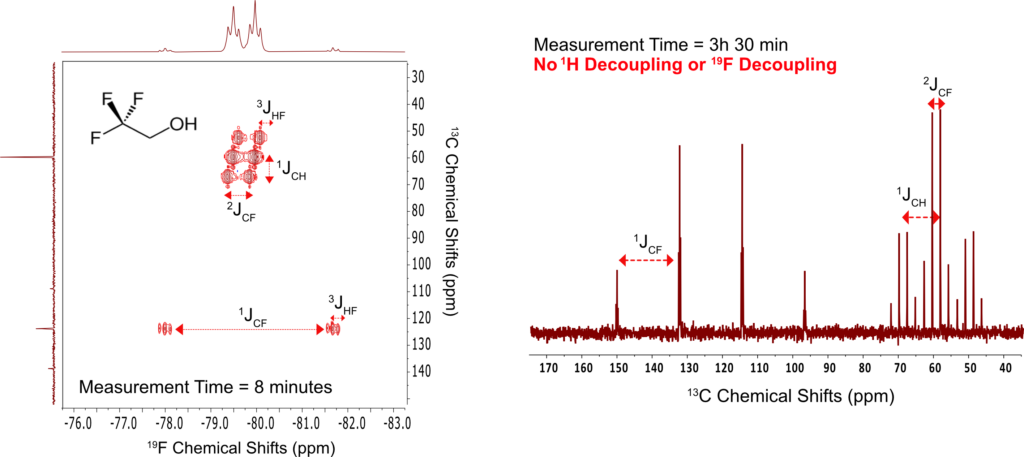
Figure 3. A 2D 19F-13C HMBC of Trifluoroethanol acquired using 4 scans, 128 increments and 1s repetition delay. The 1D 13C spectrum with no 1H and 19F Decoupling is acquired using 2048 scans with 3s repetition delay. Provide the value of the coupling constants.
The 19F-13C HMBC experiment resolves most of the heteronuclear couplings in the molecule. However, resolving the 2JCH couplings, which is often < 10 Hz, proves difficult since the couplings are comparable to the linewidth in the indirect dimension. Nevertheless, achieving the same information using a 1D 13C coupled NMR spectrum would take approximately 3 hours to acquire, whereas the HMBC experiment requires only 8 minutes. This substantial reduction in time is highly advantageous for applications that rely on J-coupling measurements.
Moreover, even a single 19F nucleus can serve as a useful probe for structural elucidation. When used as a molecular probe, 19F enables the assignment of different 13C resonances based on their proximity to the fluorine atom. To illustrate this approach, a sample of 4-fluorobenzaldehyde was examined. A series of 19F-13C HMBC spectra (see Fig. 4) were acquired using different long-range coupling values. By examining the vertical 13C projections of these spectra, the influence of long-range nJCF couplings on signal intensity can be evaluated, allowing the corresponding 13C resonances to be assigned. In particular, the buildup of signal intensity for different carbon positions reflects the magnitude of their long-range nJCF couplings. Consequently, analysis of the signal buildup curves enables 13C assignments to be made according to their relative positions with respect to the 19F nucleus. (Note: Similar information can be achieve using a 1D 13C{1H} NMR spectrum, albeit less sensitive due to the coupling of the fluorine.)
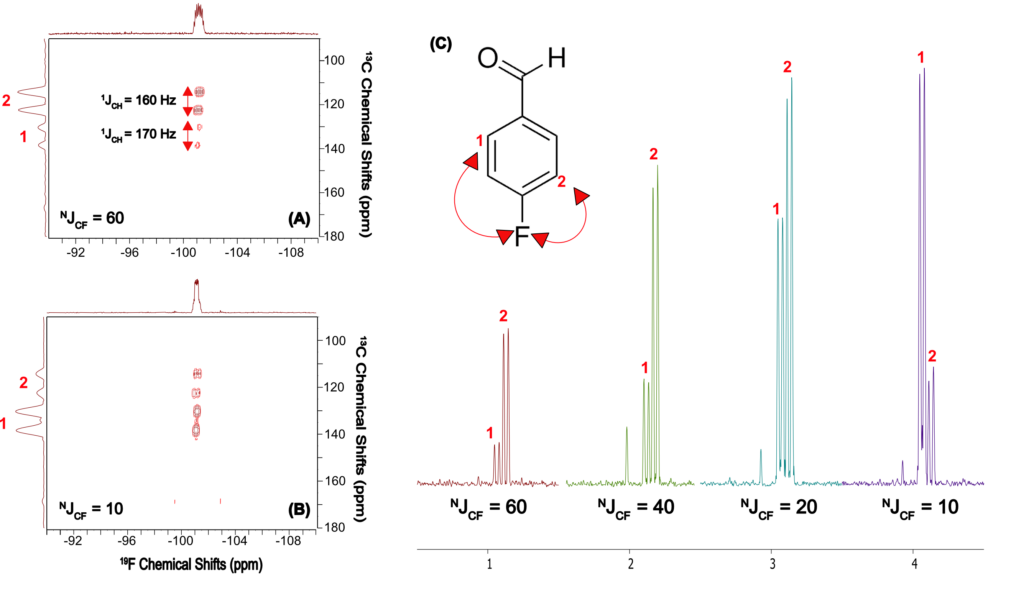
Figure 4. A series of 2D 19F-13C HMBC spectra acquired using (A) long range nJCF = 60 Hz and (B) nJCF = 10 Hz. (C) A horizontal projection of the 13C indirect dimension for different long range nJCF coupling values.
Conclusion
19F-13C HSQC and HMBC experiments provide a powerful means of characterizing fluorinated compounds, offering structural information that is difficult to obtain by other methods. HSQC delivers direct correlations between fluorine and carbon spin pairs, which is particularly advantageous for perfluorinated molecules where proton‑based experiments offer limited insight. For partially fluorinated systems, 19F–13C HMBC extends this capability by revealing long‑range heteronuclear J‑couplings that help define substitution patterns and confirm key structural features. Since fluorinated compounds exhibit substantial chemical and architectural diversity, these complementary 2D experiments form an essential toolkit for confident structure determination and compound identification. Coupled with automated heteronuclear switching that enables back‑to‑back acquisition of 1H–13C and 19F–13C spectra, the approach delivers a flexible, high‑performance NMR workflow for accurate assignments and detailed molecular analysis. In a subsequent application note, a series of per‑ and polyfluoroalkyl compounds will be analyzed using the 19F-13C HSQC and HMBC experiments.
References
[1] Takaski, M.; Kimura, K.; Kawaguchi, K.; Abe, A.; Katagiri. G.; Macromolecules 2005, 38, 14, 6031-6037.
[2] Maute, S.A.; Marchione, A. A.; Diaz, E.; Journal of Fluorine Chemistry, 2023,272,110204.
[3] Garcia-Perez, D.; Lopez, C.; Claramunt, R.; Alkorta, I.; Elguero, J.; Molecules, 22, 2003, doi: 10.3390/molecules22112003
[4] Ampt., K.; Aspers, R.; Dvortak, P.; Van der Werf, R.; Wijmenga, S.; Jaeger, M.; Journal of Magnetic Resonance, 2012, 215, 27-33
To get the complete App Note please Click Below