
701. Tetrazole-functionalized poly(oxindole biphenylene) ion-solvating membranes for alkaline water electrolysis
Yifan Xia, Sinu C. Rajappan, Mikkel Rykær Kraglund, Dmytro Serhiichuk, Dong Pan, Si Chen, Jens Oluf Jensen, Patric Jannasch and David Aili, Journal of Power Sources(2025), DOI: 10.1016/j.jpowsour.2025.238047
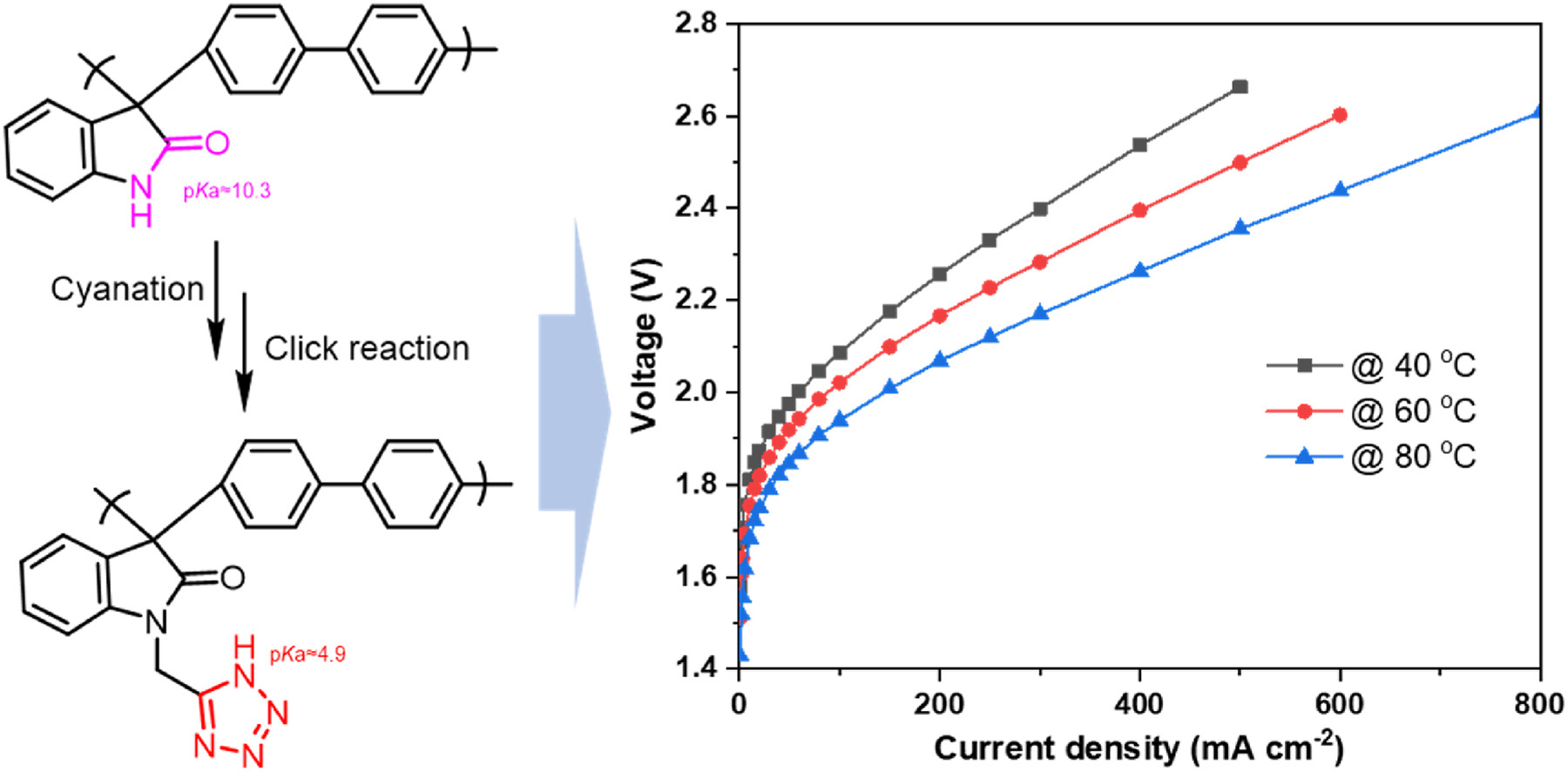
Poly(oxindole biphenylene) was functionalized with tetrazole pendants and evaluated as base material for alkaline ion-solvating membranes for water electrolysis. The poly(oxindole biphenylene) parent polymer was obtained by superacid catalyzed polyhydroxyalkylation and subsequently functionalized by cyanoalkylation. The cyanoalkyl groups were thereafter converted to tetrazole pendants by a click type [3 + 2] cycloaddition with sodium azide. The ion conductivity in 30 wt% KOH varied with the degree of functionalization, and reached 11 mS cm−1 at room temperature for the fully functionalized membrane. In water electrolysis tests, it supported current densities up to 800 mA cm−2 with uncatalyzed Ni-foam electrodes at a cell voltage of around 2.6 V. After 330 h of electrolysis operation at 80 °C in 30 wt% KOH, and 500 h cell test in total, FTIR and NMR data revealed no apparent indications of polymer degradation and 90 % of the original tensile strength was maintained.