
720. Deciphering the role of amphiphilic polymer combinations in the formation of ternary griseofulvin amorphous solid dispersions
Afroditi Kapourani, Lemonia-Eleni Proaki, Maria-Emmanouela Anagnostaki, Ioannis Gkougkourelas, Panagiotis Barmpalexis, JPharmaceuticalsSci, (2025), DOI: 10.1016/j.xphs.2025.104000
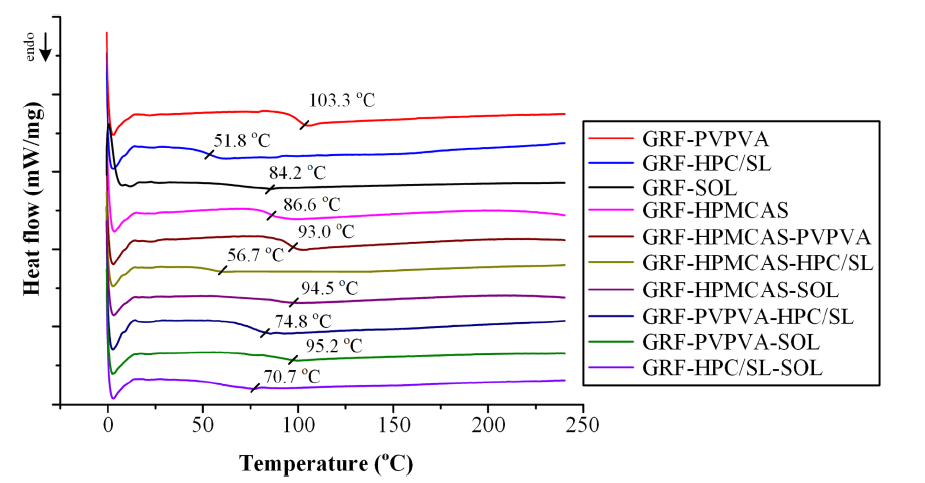
This study aims to elucidate the role of amphiphilic polymer combinations in the formation and performance of ternary amorphous solid dispersions (ASDs) of griseofulvin (GRF), a poorly water-soluble BCS Class II drug with high recrystallization tendency. Although ASDs are widely used to enhance solubility and oral bioavailability, achieving long-term physical stability and sustained supersaturation (especially at high drug loadings) remains a major formulation challenge. In this context, we systematically investigated the synergistic potential of combining amphiphilic polymers with differing hydrophilicity, namely hydroxypropyl cellulose/SL (HPC/SL), Soluplus® (SOL), copovidone (PVPVA), and hypromellose acetate succinate (HPMCAS), to form stable and effective binary and ternary GRF ASDs. The study employed a comprehensive experimental design, including thermal and solid-state characterization (TGA, DSC, pXRD, PLM), miscibility screening, molecular interaction analyses at the solid (via ATR-FTIR) and the solution (via ¹H-NMR) state. Dissolution studies were also conducted under non-sink conditions to evaluate supersaturation behavior and precipitation inhibition. Results revealed that ternary ASDs, particularly the HPMCAS-HPC/SL system, provided superior stabilization of amorphous GRF at both low (30% w/w) and high (50% w/w) drug loadings. Solid- and solution- state spectroscopic data confirmed the presence of strong and specific intermolecular interactions only in this ternary system, correlating with enhanced physical stability and prolonged supersaturation. Solution-state dynamics using T1 relaxation time measurements indicated restricted molecular mobility, supporting the hypothesis of cooperative polymer drug interactions. Overall, this work advances the understanding of how amphiphilic polymer combinations influence the physical and biopharmaceutical performance of ternary GRF ASDs. The findings provide a rational framework for designing synergistic polymer matrices that enable high drug loading while ensuring stability and dissolution enhancement, critical factors for next-generation oral dosage forms of challenging active pharmaceutical ingredients (APIs) like GRF.