
809. Polymer-Embedded Deep Eutectic Solvents: Mechanistic Insights into Storage and Supersaturation Stabilization
Afroditi Kapourani, Theodora Karyofylli-Tamisoglou, Ioannis Pantazos, Maria-Emmanouela Anagnostaki, Ioannis Gkougkourelas, Panagiotis Barmpalexis, Polymers, (2026), 10.3390/polym18060766
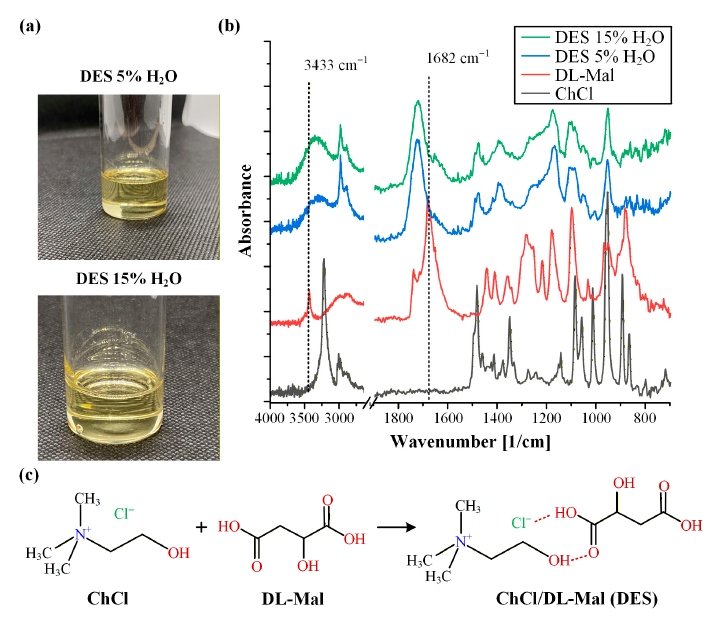
Poor aqueous solubility remains a major limitation for the oral delivery of many active pharmaceutical ingredients (APIs). Deep eutectic solvents (DESs) exhibit remarkable drugsolubilization capacity, yet rapid precipitation upon aqueous dilution can compromise their ability to sustain supersaturation. This study investigates polymer-embedded DES (PEDES) systems as liquid supersaturating drug delivery platforms in which hydration and polymer chemistry jointly govern thermodynamic solubilization and kinetic stabilization. A choline chloride/DL-malic acid DES was prepared with 5% or 15% (w/w) water and combined with polyvinylpyrrolidone (PVP) or polyacrylic acid (PAA). Griseofulvin (GRF) was used as a precipitation-prone model drug. Structural characterization (ATR-FTIR, 1H-NMR), equilibrium solubility measurements, storage stability studies, and non-sink dissolution testing were conducted to elucidate formulation behavior. The DES systems enhanced GRF solubility by up to ~59-fold relative to phosphate buffer (PBS, pH 6.8). Polymer incorporation produced hydration- and concentration-dependent effects. These results suggest the presence of competitive or cooperative interaction regimes. At 5% water, PEDES formulations failed to prevent recrystallization and showed limited supersaturation maintenance. In contrast, PEDES systems containing 15% water exhibited improved stability, with the formulation containing 4% PAA sustaining elevated drug concentrations for 120 min under non-sink conditions. Low-frequency solution-state 1H-NMR confirmed stronger GRF–PAA interactions relative to PVP, supporting the role of polymer–drug association in supersaturation stabilization. These findings demonstrate that PEDES performance emerges from a hydration-dependent balance between solvent structuring and drug–polymer interactions, highlighting hydration and polymer functionality as key parameters for the rational design of liquid supersaturating systems.