
810. Nernstian Diagnostics of Imperfect Selectivity in Naphthalene Diimide-Based Aqueous Organic Redox Flow Battery
Faudillah Alhumairah, Viktor Gueskine, Tobias Abrahamsson, Ivan Hetman, Frida Domeij, Per Leandersson, Xenofon Strakosas, Cedrik Wiberg, Reverant Crispin, Mikhail Vagin, AdvancedScience, (2026), 10.1002/advs.74945
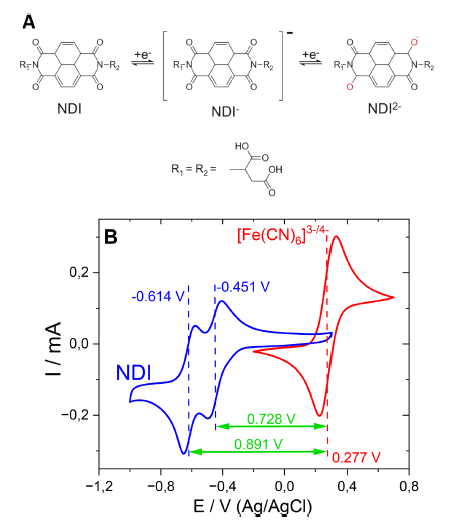
Aqueous organic redox flow batteries (AORFBs) enhance the sustainability of battery energy storage systems (BESS), supporting a greater integration of renewable electricity into the grid. We investigated the aspartate-derived naphthalene diimide (NDI)-based AORFB by independent monitoring of the individual electrode potentials on positive and negative electrodes. The mapping of these electrode potentials against analytically calculated states of charge (SOCs) for the negative and positive electrodes showed good agreement. This manifests the Nernstian behavior of electrode potentials defined by non-ideal redox electrolytes. Evidence was obtained for both the re-oxidation of charging products at the negative electrode by oxygen traces and their hydrolysis, which were conceptualized as redox shunt and irreversible degradation, respectively. The contributions of these processes to performance deterioration were illustrated using theoretical charging profiles.