
814. Design of Side-Chain Fluorinated Polyethers Featuring Predefined Breaking Points for Fluorosurfactant Applications
Tom Reimers, Larissa Limmer, Gregor M. Linden, Johannes Liermann, Reiner Friedrich, and Holger Frey, ACSAppliedPolymerMat, (2026), 10.1021/acsapm.6c00173
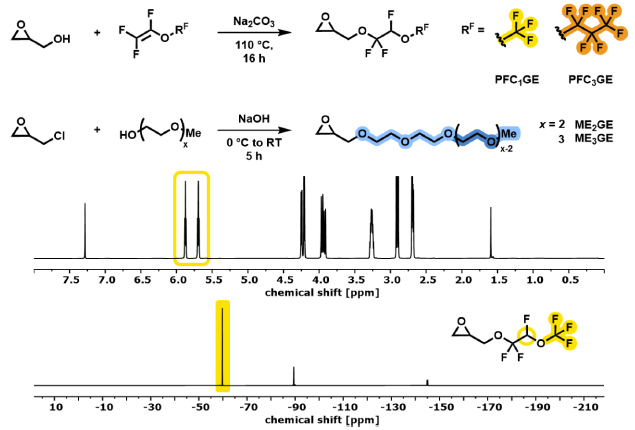
Fluorosurfactants are an integral part of many industrial processes due to their unparalleled surface activity and high water and oil repellency and can be found in a wide range of consumer products. However, their lack of biodegradability causes great environmental concern and has led to increased regulatory action in recent years. In the search for alternatives, perfluoropropyl vinyl ether was recently identified as a promising building block with an improved ecological profile regarding degradation and accumulation. Here, we utilized short-chain perfluoropropyl vinyl ether (PPVE) or perfluoromethyl vinyl ether (PMVE) as precursors to construct polyether-based fluorosurfactants through copolymerization with hydrophilic comonomers. Surfactant properties and overall fluorine content per molecule could be easily adjusted by changing the comonomer feed. The surface activity was investigated in aqueous solution via tensiometry and was found to be competitive with both legacy PFAS such as perfluorooctanesulfonic acid and current state-of-the-art small molecule fluorosurfactants (γstat ≥ 20.35 mN m−1). These findings illustrate the potential of amphiphilic copolymers as a modular, straightforward, and versatile platform for next-generation fluorosurfactants as an alternative to long-chain legacy PFAS.