
839. Characterization and impact of polyvinyl butyral binder quality in ceramic tape casting
Anne Lyck Smitshuysen, Kjeld Bøhm Andersen, Federico Capotondo, Federico Palmerini, Lene Knudsen, Kristoffer Almdal, Wolff-Ragnar Kiebach, Henrik Lund Frandsen, Søren Højgaard Jensen, Bhaskar Reddy Sudireddy, MatDesign, (2026), 10.1016/j.matdes.2026.116202
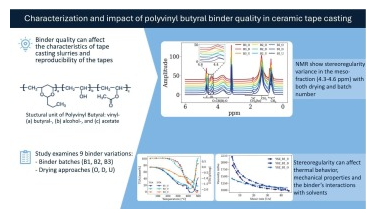
Inconsistencies observed in ceramic tape casting when introducing new batches of polyvinyl butyral (PVB) binder with identical nominal specifications motivated a systematic investigation into how subtle binder variations influence processing and tape quality. Three PVB binders from different production batches and storage conditions were examined with respect to thermal decomposition behavior, molecular weight, and functional group characteristics. Their effects on slurry formulation and tape properties were assessed through rheological measurements, particle size analysis, sintering behavior, and microstructural evaluation. Differential scanning calorimetry yielded slight variations in glass transition temperature (Tg), where oven drying increased Tg by up to 2 °C. Simultaneous thermal analysis showed differences in decomposition kinetics, particularly between 200 and 330 °C, where the temperature of 20 % mass loss ranged from 278 to 322 °C depending on binder history. Size exclusion chromatography indicated significant batch-to-batch variability, with measured average molecular weights up to 18000 g/mol lower than manufacturer specifications. Nuclear magnetic resonance analysis showed notable variations in stereoregularity. Changes in binder batches led to tape defects such as oily surfaces, excessive flexibility, and droplet formation. These issues were resolved by adjusting the organic formulation, specifically by reducing polyethylene glycol plasticizer content by 20 %, resulting in defect-free tapes.