
738. ¹⁵N NMR Signal Amplification by Reversible Exchange of [¹⁵N₃]Ornidazole Antibiotic
Anna P. Yi, Nikita V. Chukanov, Mohammad S. H. Kabir, Alexandra I. Trepakova, Eduard Y. Chekmenev, Oleg G. Salnikov, Igor V. Koptyug, JChemPhysB, (2025), 10.1021/acs.jpcb.5c05057
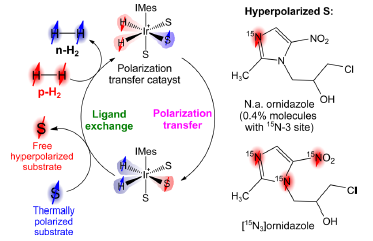
Hyperpolarization techniques provide a dramatic enhancement of the sensitivity of magnetic resonance spectroscopy and imaging. Signal amplification by reversible exchange in shield enables alignment transfer to heteronuclei (SABRE-SHEATH) is an efficient technique for hyperpolarization of 13C and 15N nuclei in various biologically relevant compounds. Nitroimidazole antibiotics are prone to reduction under anaerobic conditions, making them prospective molecular contrast agents for the visualization of hypoxic tumors. In this work, we systematically studied 15N SABRESHEATH hyperpolarization of the ornidazole antibiotic at natural abundance (n.a.) of the 15N isotope and in the isotopically 15N3-labeled form. Optimization of such experimental conditions as polarization transfer magnetic field, temperature, parahydrogen pressure, and flow rate resulted in average 15N polarization levels of 9.3 ± 0.5% for n.a. ornidazole and 5.3 ± 0.2% for [15N3]ornidazole. T1 polarization decay time of 7.4 min was achieved for the 15NO2 group of [15N3]ornidazole at a clinically relevant 1.4 T magnetic field, allowing for the detection of the 15N NMR signal more than 20 min after hyperpolarization. DFT calculations of 15N chemical shifts for ornidazole and plausible intermediates and products of its reduction under hypoxic conditions showed that it should be feasible to discriminate these compounds by using 15N NMR.