
760. Metabolomic signatures of tuberculosis and paratuberculosis in goats revealed by high-resolution and benchtop NMR spectroscopy
Muhammad Adrian, Kathrin Marina Eckert, M. Raquel Serial, Artyom Tsanda, Lukas Rennpferdt, Stefan Benders, Hoc Khiem Trieu, Tobias Knopp, Irina Smirnova, Alexander Penn, VetRes, (2025), 10.1186/s13567-025-01686-7
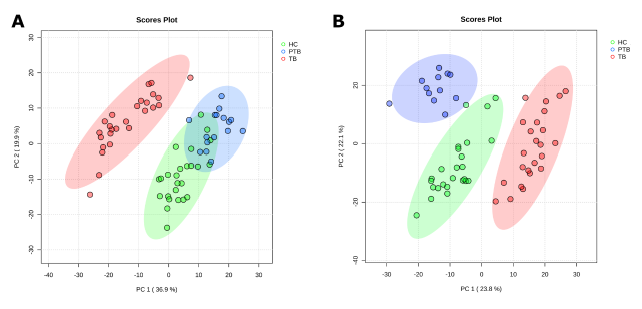
Goats represent a significant reservoir for tuberculosis (TB) in animals, contributing notably to Public and animal Health challenges, causing economic repercussions. The ante-mortem diagnosis of TB is hindered by the limited sensitivity of available techniques and false-positive results from other mycobacterial infections, like paratuberculosis (PTB). Nuclear Magnetic Resonance (NMR)-based metabolomics provides unique fingerprinting of the disease’s metabolic status, making it a promising diagnostic tool. However, conventional High-Resolution NMR has limitations in veterinary practice, where high costs and large equipment size are major constraints. Benchtop NMR spectrometer is proposed as a compact, cost-effective alternative for livestock farms. The study aimed to evaluate NMR-based metabolomics as a diagnostic tool and transfer it from High-Resolution to benchtop NMR spectrometer in an animal setting. Serum samples from TB-infected, PTB-infected (n=16) and healthy control goats (HC) were analyzed by both High- Resolution and Benchtop NMR spectroscopy. Multivariate Statistical Analysis successfully differentiated groups based on their metabolic profiles with both spectrometers. We identified that betaine, glucose, glycerol and lactate are significantly capable of distinguishing between the three groups. Additionally, 3-hydroxybutyrate, creatine, glutamate, leucine, lysine, phenylalanine, threonine and tyrosine further differentiate TB from HC. Acetate, creatine, glutamate, isoleucine, leucine and lysine distinguish TB from PTB, while 3-hydroxybutyrate, and phenylalanine serve to differentiate PTB from HC. Analyses with both, High-Resolution and benchtop, spectrometers demonstrated high sensitivity, accuracy and reliable metabolite identification. These findings highlight NMR’s spectroscopy potential to identify biomarkers associated with TB and PTB infection, improving health management in livestock.