
764. Biocompatible SABRE Hyperpolarization of [1-¹³C]Ketoleucine for Cellular Metabolic Flux Sensing
Patrick TomHon, Joseph Gyesi, Abubakar Abdurraheem, Stephen McBride, Anna Samoilenko, Clementinah Oladun, Erica Curran, Megan Pike, Sydney D.Welch, Sydney Scofield, Boyd M. Goodson, Marianna Sadagurski, Thomas Theis, Eduard Y. Chekmenev, ChemistryAEuropeanJ, (2025), 10.1002/chem.202502734
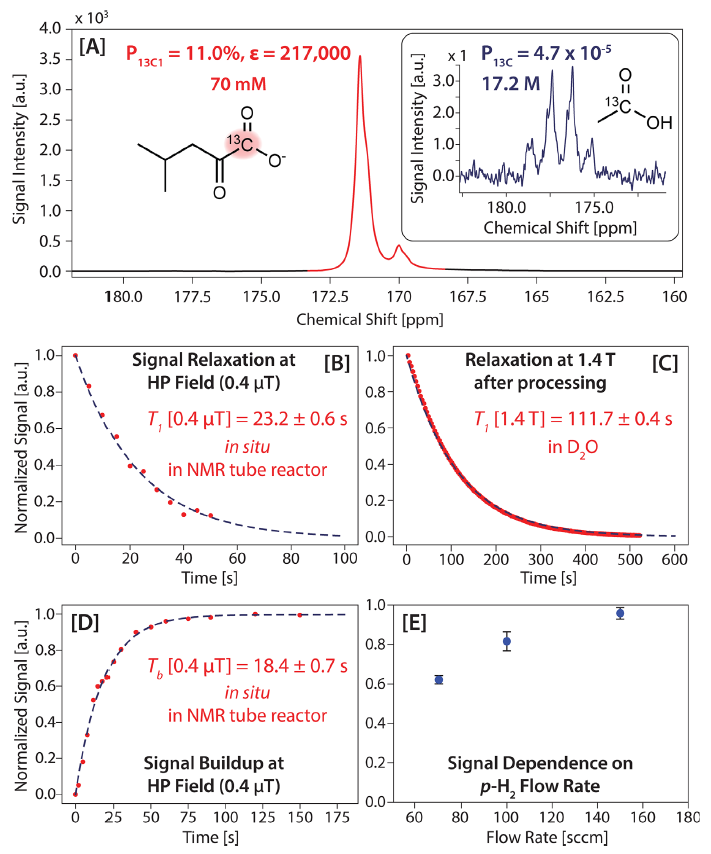
Ketoleucine (α-ketoisocaproate) is a novel hyperpolarized substrate for noninvasive metabolic imaging, enabling rapid, high sensitivity detection of branched-chain amino acid flux, a pathway that is aberrant in many diseases including cancer and Alzheimer’s disease. Utilizing NMR Signal Amplification by Reversible Exchange (SABRE) with an 80:20 acetone:water solvent system, we achieved >11% polarization of [1-13C]ketoleucine (corresponding to signal enhancement over 230,000-fold at 0.55 T) at 70 mM within 2 min, using parahydrogen as a cheap and fast source of hyperpolarization. A two-stage liquid–liquid extraction and gas stripping protocol removes excess excipients, yielding a biocompatible aqueous solution of [1-13C]ketoleucine (79 ± 10 mM). When mixed with Saccharomyces cerevisiae (Baker’s yeast), hyperpolarized [1-13C]ketoleucine produced strong, long-lasting signals, where downstream metabolites are observed for >200 s, allowing first-order kinetic modeling of CO2 and bicarbonate. These cell experiments demonstrate both the biocompatibility and signal strength of SABRE–hyperpolarized KL, establishing KL as a versatile hyperpolarized agent and opening avenues for real-time investigation of metabolic dysregulation in cancer, neurodegenerative disorders, and beyond.