
771. Active Phase−Support Interaction in Phosphotungstic Acid-SiO₂ Catalysts Enables Enhanced Olefin Oligomerization to Synthetic Fuel
Alessia Cesarini, Walid Dachraoui, Florent J. Dubray, Filippo Longo, Jonathan Muschietti, Daniel Rentsch, Rolf Erni, Ali J. Saadun, Jeroen A. van Bokhoven, Andreas Borgschulte, ACSCatalysis, (2026), 10.1021/acscatal.5c06512
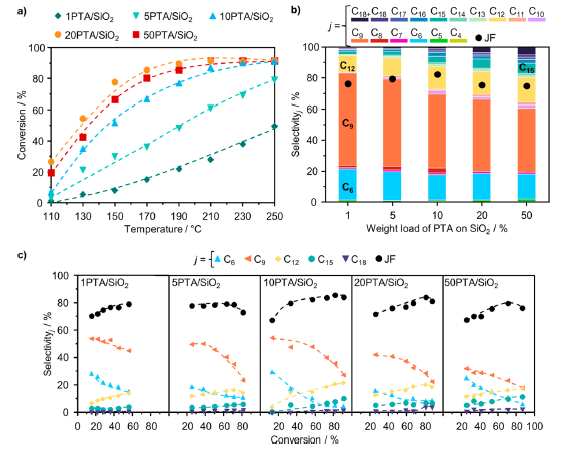
Transitioning the aviation sector to synthetic aviation fuels (SAF) requires innovative catalytic processes to overcome common limitations such as insufficient activity, selectivity, and catalyst deactivation. This study presents a detailed exploration of silica-supported phosphotungstic acid (PTA/SiO2) as a robust solid acid catalyst for propylene conversion into jet fuel-range hydrocarbons (C8 to C16) at mild reaction conditions (150 °C). The catalyst with optimized PTA loading (10 wt %) demonstrates significant oligomerization performance, achieving high selectivity to jet fuel range hydrocarbons (>80%) and propylene conversion (>90%), alongside limited aromatic byproducts formation. Compared to conventional solid-acid catalysts such as a ZSM-5 zeolite, PTA/SiO2 exhibits significantly reduced catalyst deactivation and can be regenerated through mild thermal treatment (<400 °C). Detailed structural characterization revealed that PTA island size influences product selectivity. Increasing the PTA weight loading leads to larger active phase island sizes, with larger PTA islands preferentially producing longer-chain hydrocarbons (C15+). Raman spectroscopy confirms the preservation of the PTA Keggin structural integrity across all catalyst loadings, although perturbations in terminal W=O vibrations occur due to interactions with the SiO2 support. Crucially, insights obtained through combined XPS/HAXPES analyses reveal significant electronic interactions between PTA and SiO2, characterized by pronounced bending of the energy bands at the interface between semiconducting PTA and insulating SiO2. This effect generates interfacial tungsten states, which enhance localized electron mobility and facilitate proton transfer, significantly amplifying catalytic activity. Even catalysts with minimal Brønsted acidity (1 wt % PTA loading) exhibit notable turn over, emphasizing interfacial electronic modulation, rather than bulk acidity alone, as an important performance descriptor in olefin oligomerization.