
805. Room-Temperature, Atom-Economic Closed-Loop Recycling of Thermosets Enabled by Catalyst-Free Dynamic Thiohemiketals
Qionglu Xiao, Huiya Li, Chun Liu, Xiaoyue Zeng, Shiguang Zhang, Mei Hu, Jianbing Zeng, Liang Chen, Macromolecules, (2026), 10.1021/acs.macromol.5c02725
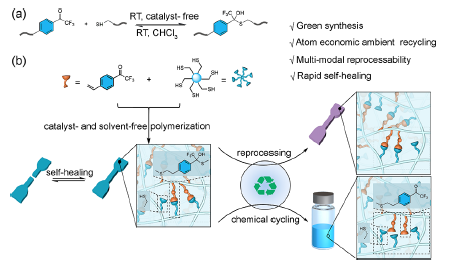
The global plastics crisis has triggered severe environmental pollution and resource depletion. While covalent adaptable networks (CANs) offer promising solutions, achieving ambienttemperature chemical recycling with quantitative monomer recovery and zero chemical consumption remains challenging. Furthermore, catalyst-free reprocessing via multiple industrial techniques under mild conditions, alongside energy-efficient and eco-benign synthesis, constitutes a critical bottleneck. Herein, we introduce thiohemiketal as a novel dynamic covalent motif for self-healing recyclable polymers. Mechanistic studies using small-molecule models reveal catalyst-free bond formation under ambient conditions, rapid dynamic exchange without catalysts, and quantitative solvolysis in chloroform at 25 °C. Leveraging this unique chemistry, we developed a solvent- and catalyst-free polymerization strategy to synthesize CANs exhibiting exceptional thermal stability, broadly tunable mechanical properties (Young’s modulus: 2.4 MPa to 1.1 GPa, spanning polydimethylsiloxane (PDMS)-like elastomers to polypropylene (PP)-like plastics), and ultrastrong adhesion (12.5 MPa lap shear strength on iron). Crucially, these networks exhibited exceptional sustainability: ambient-temperature closed-loop chemical recycling via solvolysis with quantitative recovery and no chemical consumption, catalyst-free multimodal reprocessability (compression, injection, and extrusion), and rapid self-healing. This work establishes a new paradigm for sustainable polymer design, showcasing significant potential for advanced adhesives and structural composites.