
817. Blue organic light-emitting diodes with over 20% external quantum efficiencies based on Europium(II)-emitters
Mahmoud Soleimani, Toni Bärschneider, Felix Kaden, Roman Tkachov, Sebastian Schellhammer, Sebastian Reineke, Carsten Rothe, Arxiv (a), (2026), 10.48550/arXiv.2604.06476
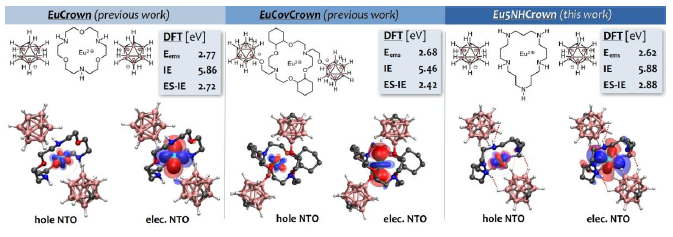
The realization of blue electroluminescence with high efficiency and lifetime remains a long-standing hurdle for OLED technology to overcome. Divalent Europium [Europium(II)] complexes offer a fundamentally distinct pathway toward this goal, as their atomic 4f–5d transitions yield single-Gaussian, spectrally pure emission with theoretical 100% exciton utilization and no involvement of fragile organic bonds in the emissive process. However, their true potential has never been fully demonstrated before. In this work, we design a rigid aza-crown europium(II) complex (Eu5NHCrown) that achieves near-unity photoluminescence quantum yield with bright, pure-blue emission. The complex sublimes without decomposition and can be vacuum-deposited into a bottom-emitting, single-host OLED architecture, delivering an external quantum efficiency (EQE) of 20.7% with minimal roll-off (19.3% at 1000 cd m−2) and a narrowband electroluminescence with Commission Internationale de L’Eclairage coordinates of (0.12, 0.25). These results reveal the true potential of Eu(II) 4f–5d transitions for high-efficiency blue OLEDs, establishing a molecular design concept that bridges atomic-transition efficiency with the processability of organic materials.