
823. Assessing Numerical Approaches for the Analysis of 1H Nuclear Magnetic Relaxation Dispersion Profiles in Clay Suspensions
Zlanseu R. Tan, Natalie Malikova, Guillaume Mériguet, Laurent Michot, Jean-Pierre Korb, François Ribot, Pierre Levitz, Anne-Laure Rollet, MagneticResonChemistry, (2026), 10.1002/mrc.70097
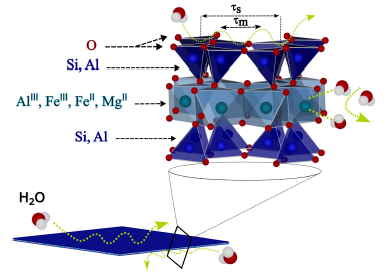
Analyzing nuclear magnetic relaxation dispersion (NMRD) profiles to determine parameters of atomic/molecular motion in complex systems is a challenging task that involves the fitting of these profiles. The choice of the theoretical model, the constraint on parameters, and their reliability are key factors for a realistic description of systems. Herein, strategies for fitting proton NMRD profiles in smectite clay aqueous suspensions are evaluated, with the aim of providing the most realistic description of water molecules dynamics at clay surfaces. Profiles are adjusted with a combination of Jean-Pierre Korb (JPK) and Solomon-Bloembergen-Morgan (SBM) model. Due to the large number of parameters involved, rigorous methodology is implemented to achieve a unique and reliable solution. Two approaches are tested. In a one-step approach, the overall theoretical model (JPK + SBM) is adjusted to experimental profile at once. In a two-step approach, the frequency ranges where JPK and SBM models prevail, and an initial set of parameters obtained from the one-step approach serve as starting point for a segmented regression procedure. Below a frequency ωI,lim chosen as the breakpoint, profiles are fitted with the JPK model (first step) and the resulting optimized parameters injected and kept constant in the global model (second step), to optimize the SBM parameters. The study is applied to montmorillonite and beidellite clay suspensions. While, for the former, both approaches lead to fairly similar and conclusive results, for the later, only the two-step approach provides a reasonable description of the system.