
838. Enabling Quantitative Benchtop ¹³C NMR Spectroscopy in Fast Continuous Flow
Sarah Mross, Hans Hasse, Kerstin Münnemann, MagnResonChem, (2026), 10.1002/mrc.70119
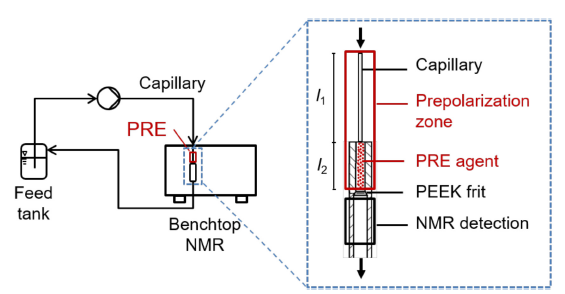
Continuous-flow benchtop NMR spectroscopy is highly attractive for quantitative reaction and process monitoring. Although 1H NMR spectroscopy is widely used, signal overlap frequently compromises quantitative analysis. In principle, this limitation can be addressed by 13C NMR spectroscopy; however, its application is restricted by the inherently low sensitivity of 13C nuclei. This limitation is further aggravated by insufficient polarization buildup in benchtop NMR spectroscopy in fast continuous flow, as the compact design provides only short residence times in the premagnetization zone. We demonstrate here that the latter limitation can be overcome by paramagnetic relaxation enhancement (PRE). Furthermore, we demonstrate that applying PRE is particularly effective when combined with a method that enhances weak 13C polarization, such as 1H to 13C polarization transfer. For this, we used PENDANT. We report the first application of PRE (with and without PENDANT) for quantitative analysis of mixtures with continuous-flow 13C benchtop NMR spectroscopy. Experiments were carried out for common solvents (acetonitrile, 1,4-dioxane, and ethanol) as well as binary and ternary mixtures of these solvents over a wide range of flow rates. The results demonstrate that PRE, especially when combined with PENDANT, enables robust quantitative analysis with 13C NMR spectroscopy even at high flow rates, significantly expanding the applicability of benchtop NMR instruments for quantitative reaction and process monitoring.