1H,13C HMBC of a Precursor for Photochromic Molecules

1H,13C HMBC of a Precursor for Photochromic Molecules

Photochromic molecules are compounds whose properties such as colour change on exposure to light. They find a wide range of applications, from dyes, sensors and optic lens coatings to medical applications including photodynamic therapies. Here we demonstrate the power of using a Spinsolve 80 MHz benchtop NMR system for the structure confirmation of a precursor to a variety of photoactive molecules ((2-bromophenyl)[4-(pyrrolidin-1yl)phenyl]methanone, Fig. 1). The compound was kindly provided by Prof. Paulo Coelho, Centro di Química Via Real, Universidade de Trás-os-Montes e Alto Douro. 15 mg of material were dissolved in
200 µL of CDCl3.

Figure 1:  Structure of 2-bromophenyl)[4-(pyrrolidin-1-yl)phenyl]methanone..

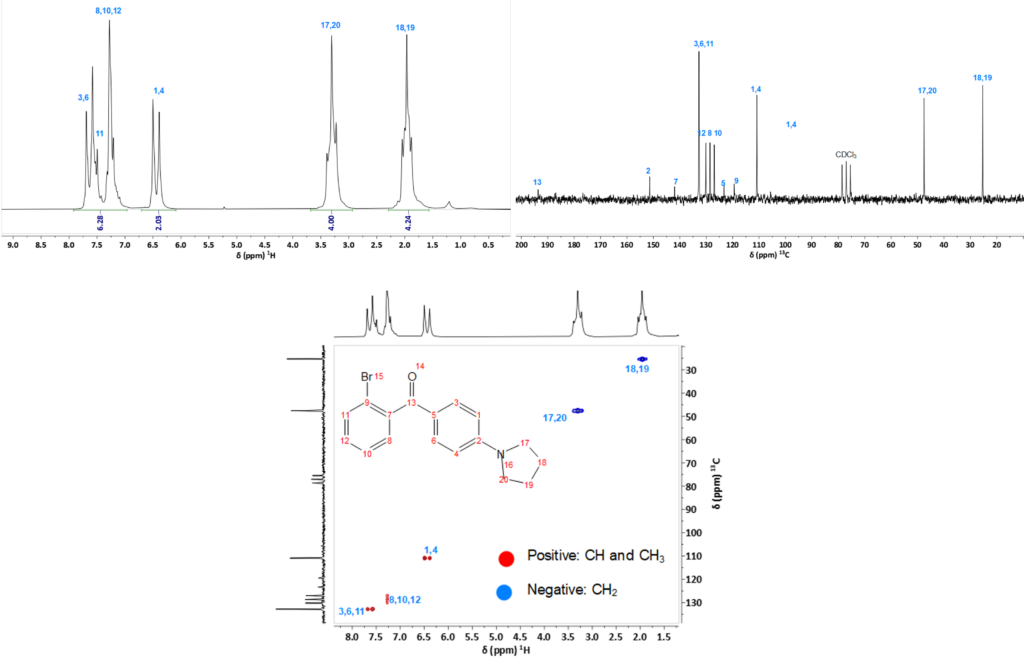
Structure confirmation is usually done with 1D 1H, and 13C{1H} as well as 2D 1H,13C HSQC spectra, with the latter often as the multiplicity-edited (ME) version, yielding positive signals for CH and CH3 and negative ones for CH2, with long range correlations from a 1H,13C HMBC employed as a backup in case of ambiguities. Fig. 2 shows the 1D 1H{13C}, 13C{1H} and 1H,13C HSQC-ME spectra of the phenyl methanone with assignments.
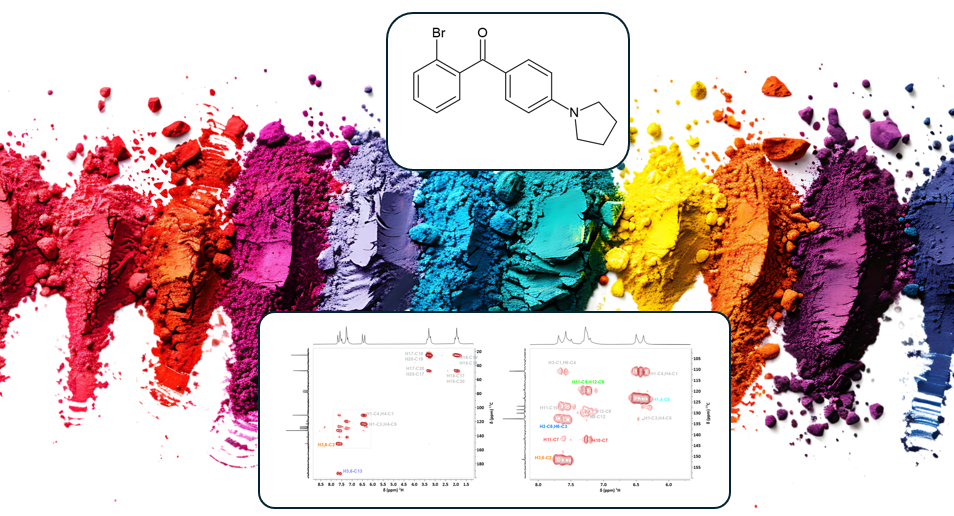
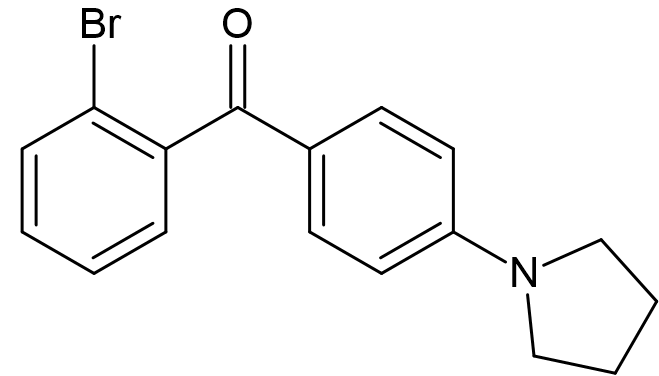
Figure 1:  1D 1H{13C} (top left), 13C{1H} (top right) and 1H,13C HSQC-ME (bottom) spectra of the phenyl methanone with assignments..

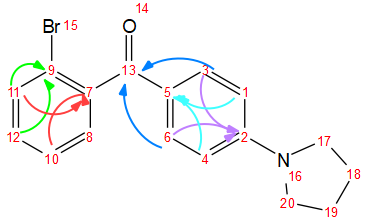
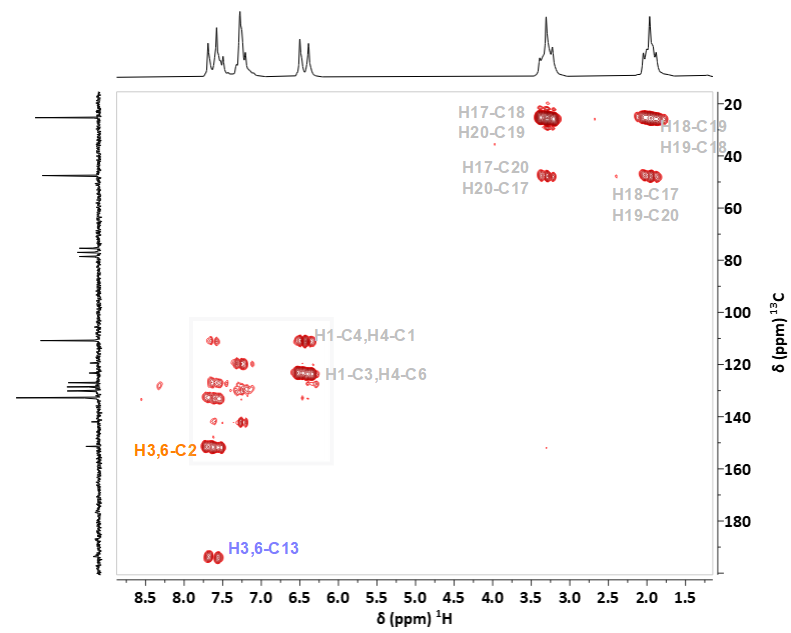
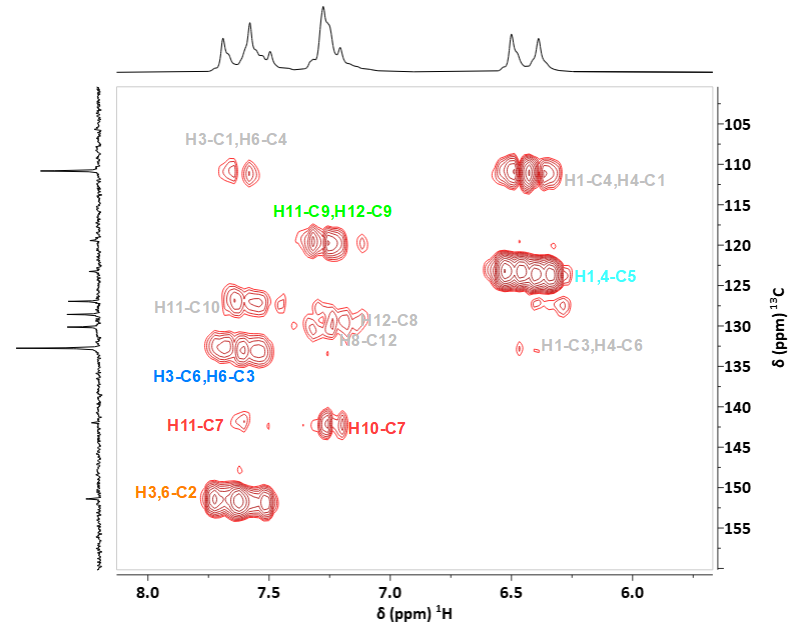
The 1H signals for H8, H10 and H12 are overlapping, while the corresponding 13C peaks are well resolved. The 1H,13C HMBC spectrum (Fig. 3) with its signals resulting from interactions across multiple bonds allows the unambiguous assignment of all signals. Correlations containing information not available from other experiments such connectivities for quaternary carbons are shown in colours and with correlation arrows, while all others are shown in grey without arrows.

Figure 3: Structure and 1H,13C HMBC spectrum (64 scans, 2 h 17 min) of the phenyl methanone with assignments and correlations, left: full spectrum (grey box indicating aromatic region), right: expansion of aromatic region, with assignments in grey for information already obtained from COSY, and in colour for new information (quaternary carbons)..

The resolution in the 1D 13C{1H} significantly aids in disentangling of the closely grouped signals in the aromatic region in the HMBC spectrum, showing that on a benchtop NMR system structure confirmation and elucidation for small molecules are readily achievable.