
Monitoring biocatalytic reactions using benchtop NMR spectroscopy
Real-time quantification of substrate consumption and product formation in enzymatic reactions using benchtop NMR
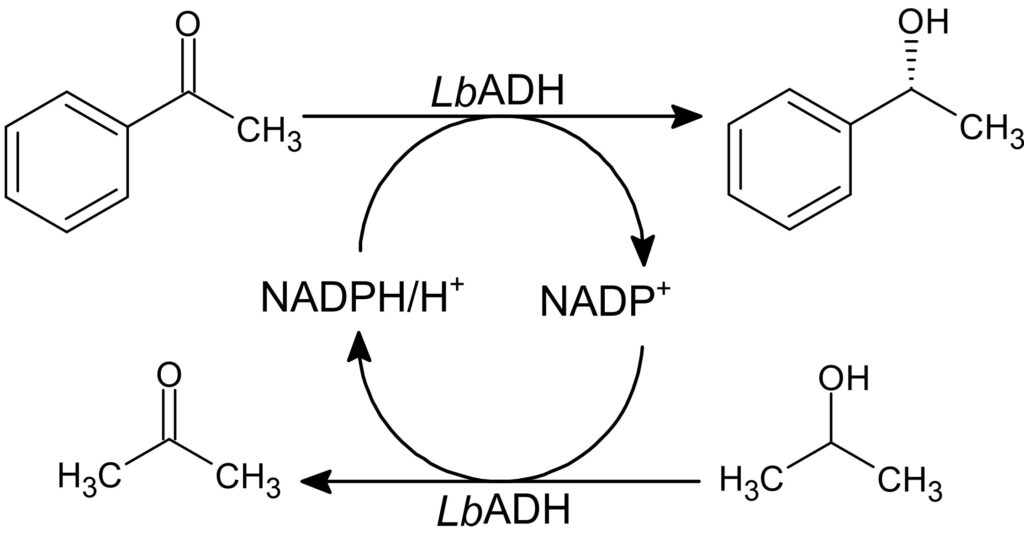
Scheme 1: Reduction of acetophenone by alcohol dehydrogenase from Lactobacillus brevis (LbADH) to 1-phenylethanol coupled to a co-factor recycling reaction.
Benchtop NMR spectroscopy provides a direct and quantitative approach to monitor enzymatic reactions in real time. Substrates and products can be measured directly, without the need for surrogate substrates or deuterated solvents, while reactions can be performed in standard biochemical buffers and with crude cell lysates. An increasing application area for Spinsolve benchtop NMR spectrometers is reaction monitoring[1], where researchers can follow reaction progress and obtain information on substrate consumption, product formation, and reaction kinetics directly from the reaction mixture. Understanding how enzymes transform substrates into products is essential for biotechnology, biocatalysis, and enzyme engineering. Real-time reaction monitoring provides information on enzyme activity, catalytic efficiency, and the effects of enzyme substitutions, and enables the evaluation of different reaction conditions. However, traditional analytical approaches often require sampling, quenching, and additional preparation steps, which can limit temporal resolution and require separate methods for substrate and product analysis. The combination of direct product detection and quantitative reaction monitoring provides a practical approach for enzyme screening, kinetic characterization, and reaction optimization. Enzyme variants can be evaluated under defined reaction conditions and compared based on their catalytic performance, while enzymatic conversions can be monitored over extended periods without interrupting the reaction or relying on separate analytical methods.In this application note, we demonstrate how benchtop NMR can be used to monitor ketone reduction by the alcohol dehydrogenase from Lactobacillus brevis (LbADH) coupled with a co-factor recycling system directly in a standard biochemical environment, consisting of a 100 mM potassium phosphate (KPi) buffer/water mixture (Scheme 1).[2] The measurements can be performed with reaction volumes as low as 200 µL, requiring only small amounts of substrate, enzyme, and cofactors, making the approach suitable for a wide range of biochemical applications. Furthermore, we demonstrate that purified enzymes are not mandatory: crude cell lysates containing membrane fragments, proteins, and other cellular components can also be directly investigated. The resulting reaction monitoring spectra obtained with purified enzyme and lysate show comparable spectral features, demonstrating that successful NMR analysis is possible even in complex biological suspensions. For this study, a Spinsolve 80 ULTRA benchtop NMR spectrometer was used with standard 5 mm NMR tubes. The ULTRA models provide enhanced spectral resolution through a highly homogeneous magnetic field, enabling the observation and quantification of substrate and product signals in conventional protonated solvents. To overcome the challenge of strong solvent resonances, the integrated WET solvent suppression technique effectively attenuates water and other solvent signals, allowing low-concentration reaction components to be monitored without signal interference. Additionally, the built-in external lock system eliminates the need for deuterated solvents or deuterium-containing components in the reaction medium. This enables measurements under native biochemical conditions and simplifies the integration of benchtop NMR into enzymatic workflows. Together, these capabilities demonstrate how benchtop NMR spectroscopy can provide rapid, quantitative, and non-invasive access to enzymatic reaction kinetics, supporting faster development and optimization of biocatalytic processes.
Experimental Setup
The kinetic parameters of LbADH were determined by monitoring the reaction at acetophenone concentrations ranging from 1 to 40 mM using a Spinsolve 80 Ultra benchtop NMR. The reaction was initiated by adding purified LbADH to the acetophenone working solution (1 – 40 mM acetophenone, 300 µM NADPH, 10% (v/v) isopropanol, 1 mM MgCl₂,100 mM potassium phosphate buffer, pH 7.0) in an NMR tube and mixing by inversion. Immediately after mixing, the tube was inserted into the NMR spectrometer.
The RMX module in the Spinsolve software was configured to monitor the reaction by repeatedly acquiring 1D-1H NMR spectra with solvent suppression and carbon decoupling (WET SUP) using the following parameters: 16 scans, 3.2 s acquisition time, 15 s repetition time, and a total experiment duration of 5.5 min. The WET suppression sequence was set to selectively suppress the water (4.8 ppm) and isopropanol signals (1.2 ppm and 4.0 ppm), as shown in Figure 1. Prior to the addition of LbADH, a reference spectrum of the working solution was acquired. The known concentration of acetophenone was used to establish the relationship between NMR signal integral and analyte concentration. Since NMR signal integrals are directly proportional to the number of contributing nuclei and their concentration, this relationship can be used to quantify the corresponding analyte throughout the reaction. This allows quantitative concentration measurements without requiring an external calibration standard for each measurement.
NMR Results & Discussion
A representative 1D-1H spectrum of the reaction acquired using a WET water suppression sequence is shown in Figure 1B. The methyl proton signals of the substrate (acetophenone), product (1-phenylethanol) and the co-factor recycling product (acetone) were well resolved and showed no overlap with the narrow residual solvent signals. As a result, the selected signals were integrated and used to monitor the reaction.
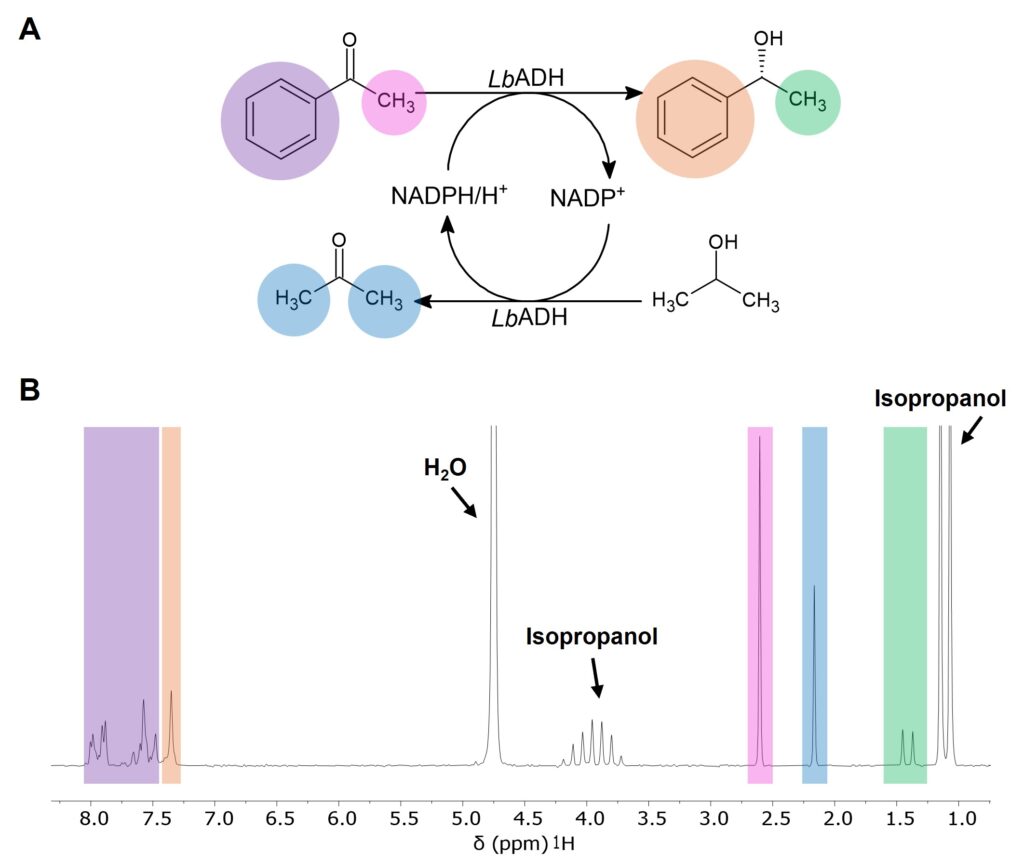
Figure 1: Reaction scheme and representative NMR spectrum of acetophenone reduction by LbADH. (A) Schematic representation of the reduction of acetophenone to 1-phenylethanol catalyzed by LbADH and coupled to a co-factor recycling reaction. (B) Representative spectrum of reaction mixture containing acetophenone and 1-phenylethanol, starting from 40 mM acetophenone (So). A WET suppression sequence was used to automatically suppress the water signal (singlet at 4.8 ppm) and isopropanol signals (doublet at 1.2 ppm and multiplet at 4.0 ppm).
Complete reduction of acetophenone was evaluated using both 10 % (v/v) LbADH-containing cell lysate and purified LbADH. The spectra show complete conversion to 1-phenylethanol, with no interference of signals from the cell lysate (Figure 2, top) compared with the reaction catalyzed by the purified enzyme (Figure 2, bottom). The WET suppression sequence enabled the resolution of the 1-phenylethanol methyl signal, which is otherwise partially covered by the isopropanol solvent signal, as shown by the unsuppressed spectrum in grey in Figure 2. Importantly, the high spectral resolution and selective solvent suppression of the Spinsolve Ultra system were unaffected by the presence of the cell lysate, allowing direct monitoring of the reaction without enzyme purification. This reduces sample preparation and facilitates the evaluation of enzyme activity and reaction kinetics in complex biological samples, making the workflow suitable for applications such as enzyme screening, protein expression analysis, and biocatalyst development.
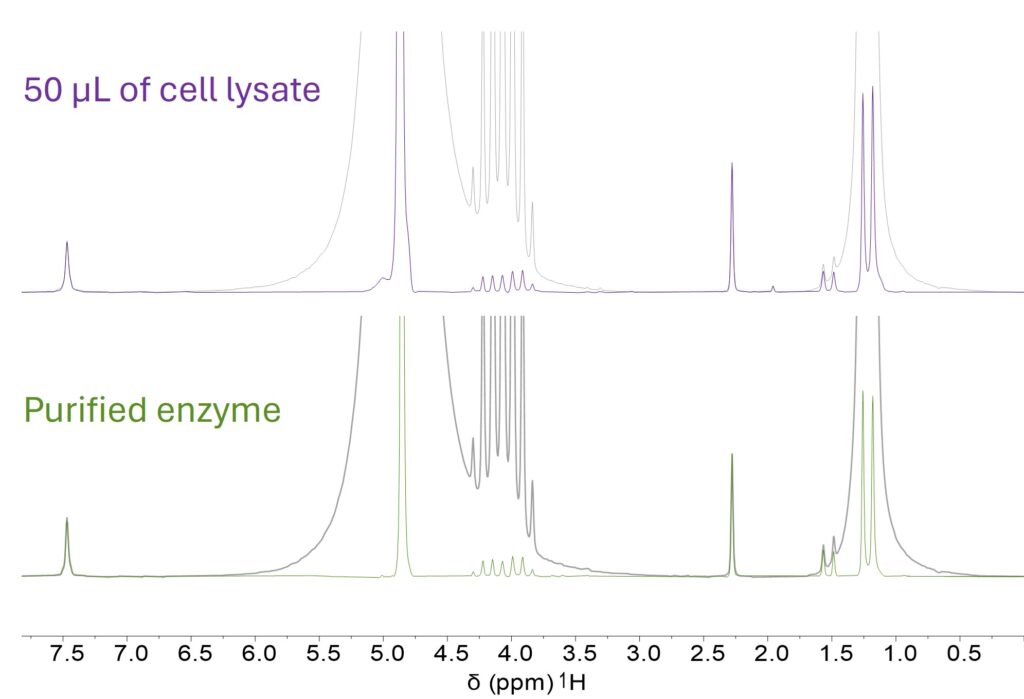
Figure 2: Reduction of acetophenone to 1-phenylethanol catalyzed by LbADH. Acetophenone was reduced using 50 µL of LbADH-containing cell lysate (top) or purified LbADH (bottom). The colored spectra were acquired with solvent suppression and carbon decoupling, while the light grey traces show the corresponding spectra without solvent suppression.
The kinetics parameters, such as Km and Vmax, were determined for LbADH under the described reaction conditions. The signals of acetophenone, 1-phenylethanol and acetone were monitored in real time, and the initial velocity (V0) was calculated from the reaction progress curves over an initial acetophenone concentration range of 1 to 40 mM acetophenone. A representative progress curve is shown in Figure 3A for an initial acetophenone concentration of 20 mM. The three monitored signals showed low scattering with R2 > 0.99 and yielded an average initial velocity of 49.2 ± 1.1 µM min-1. The reaction progress curves obtained from 1-phenylethanol (green), and acetone (blue) showed excellent agreement throughout the reaction (Figure 3A), consistent with the expected stoichiometry of the cofactor recycling reaction. The corresponding stacked NMR spectra are shown in Figure 3B. The simultaneous quantification of substrate, product, and cofactor recycling components provides multiple independent measurements of the same reaction, allowing the reaction progress and calculated initial velocities to be verified from a single experiment. This eliminates the need for separate analytical methods to quantify substrates and products while providing a direct measure of reaction conversion over time.
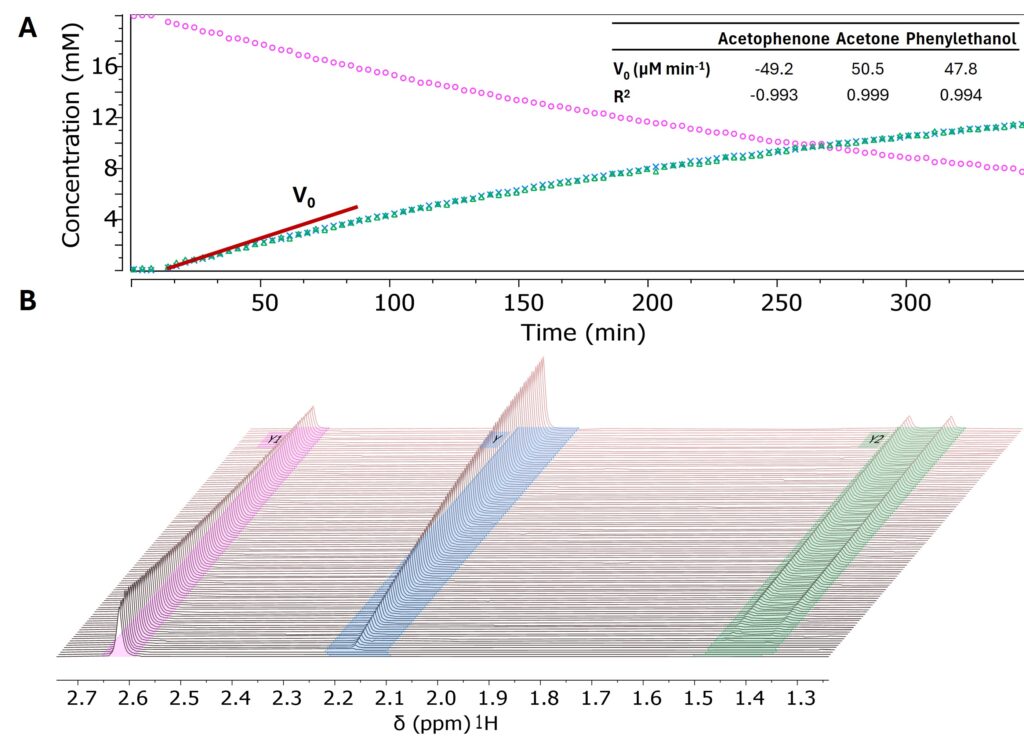
Figure 3: LbADH-catalyzed reduction of 20 mM acetophenone. (A) Representative reaction progress curve showing acetophenone depletion (pink) and the formation of 1-phenylethanol (green) and acetone (blue). The initial velocities (V0) were calculated from the linear region of each progress curve. (B) Stack plot of solvent-suppressed 1H NMR spectra acquired during the reaction.
A Michaelis–Menten plot was generated by plotting the calculated initial velocities (V₀) against the initial acetophenone concentration. Fitting the data to the Michaelis–Menten equation yielded a Km = 2.5 ± 0.1 mM and a Vmax = 59.2 ± 0.8 µM min-1. The measured Km is within the range of reported values for LbADH with acetophenone [2,3]. The calculated kinetic parameters demonstrate that benchtop NMR can be used to obtain quantitative enzyme kinetics directly from reaction progress data. By simultaneously monitoring substrate depletion and product formation in a single experiment, the method provides a straightforward approach for kinetic characterization without additional analytical assays, and no measurements of external calibration curve are needed.
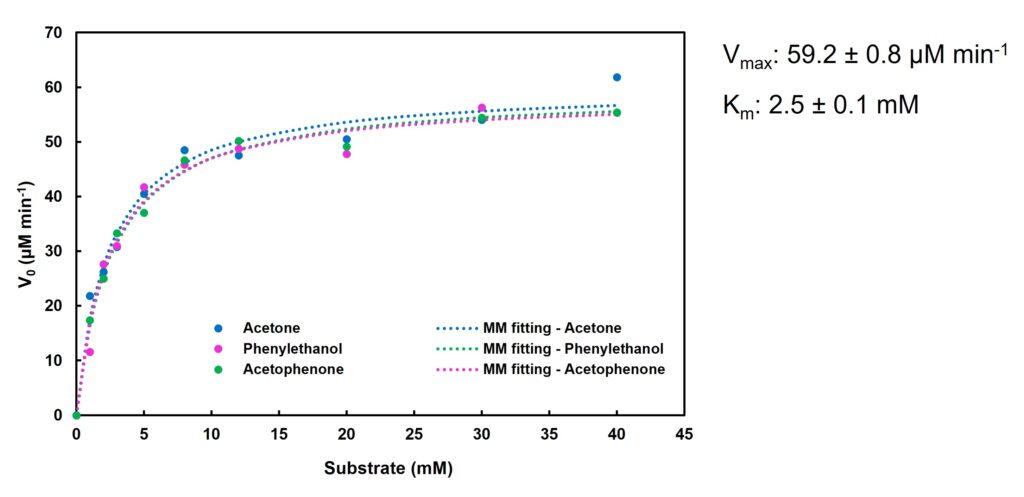
Figure 4: Michaelis-Menten kinetics of LbADH-catalyzed acetophenone reduction. Initial modular velocities (|V0|) derived from each progress curve were independently fitted to the Michaelis-Menten equation (MM fitting) to determine Km and Vmax of the three monitored signals: acetophenone (pink), 1-phenylethanol (green), and acetone (blue).
Conclusion
The reduction of acetophenone by LbADH was successfully monitored in real time using a Spinsolve 80 Ultra benchtop NMR. Direct detection of acetophenone, 1-phenylethanol, and acetone enabled simultaneous monitoring of substrate consumption, product formation, and cofactor recycling, and allowed reaction rates to be calculated directly from the NMR data. The obtained kinetic parameters are comparable to reported Km values for LbADH. The reaction was monitored under standard biochemical conditions in aqueous buffer and protonated solvents, without the need for deuterated solvents, and could also be measured directly in crude cell lysate without enzyme purification. These features provide a straightforward approach for the quantitative analysis of biocatalytic reactions without the need for surrogate substrates, from enzyme activity screening and kinetic characterization to biocatalyst development and reaction optimization. By combining real-time monitoring, direct product detection, and measurements in complex biological samples, benchtop NMR can support the evaluation of enzyme performance throughout the biocatalysis workflow.
References
- Li, G. Q., Kiyomura, S., Yamamoto, Y., & Miyaura, N. (2011). Direct conversion of pinacol arylboronic esters to aryl Chemistry Letters, 40(7), 702-704.
- Baumer, B., Classen, T., Pohl, M., & Pietruszka, J. (2020). Efficient nicotinamide adenine dinucleotide phosphate [NADP (H)] recycling in closed‐loop continuous flow biocatalysis. Advanced synthesis & catalysis, 362(14), 2894-2901.
- Rodríguez, C., Borzęcka, W., Sattler, J. H., Kroutil, W., Lavandera, I., & Gotor, V. (2013). Steric vs. electronic effects in the Lactobacillus brevis ADH-catalyzed bioreduction of ketones. Organic & biomolecular chemistry, 12(4), 673-681.
- Kulishova, L. (2010). Analysis of factors influencing enzyme activity and stability in the solid state. Heinrich-Heine University, Düsseldorf, Doctoral
Acknowledgement
We would like to thank Prof. Dr. Jörg Pietruszka for providing the purified LbADH enzyme used in this study.
To get the complete App Note please Click Below